Quick answer: An automated tool checkout kiosk replaces a manual tool-crib logbook with credential-based, per-transaction control. For MRO and tool-crib buyers, the decision comes down to four specs: identification method, cabinet/enclosure durability and IP rating, integration with your CMMS/EAM, and the audit t
Overview
Quick answer: An automated tool checkout kiosk replaces a manual tool-crib logbook with credential-based, per-transaction control, so every issue and return is tied to a named person, a timestamp and a specific tool. Four specs decide whether the project works: identification method (RFID, barcode, PIN or badge); enclosure durability and IP rating for the plant floor; integration with your CMMS/EAM or access-control system; and an audit trail you can export. Get any one of them wrong and the kiosk becomes an expensive drawer.
Why MRO buyers replace the paper logbook
A manual tool crib loses money in ways that never show on a purchase order: tools walk off, high-value items get signed out by the wrong shift, calibration dates lapse, and nobody can prove who had what during a line-down event. An automated checkout kiosk converts those soft losses into hard, exportable data.
The sourcing decision therefore is not “do we want self-service” — it is “which hardware spec removes the risk we can actually measure.” That reframing matters because it changes what you compare suppliers on.
Scenario fit: which environments justify a kiosk
An automated tool checkout kiosk pays back fastest where three conditions overlap: high-value assets , many users , and a compliance or audit reason to know who holds what. Typical fits:
- MRO / maintenance storerooms — fits when one storeroom issues high-value, serialized items (torque tools, calibrated instruments, PPE with expiry dates) to many technicians per shift.
- Tool-crib rooms in manufacturing — fits when a shared tool must be returned before the next shift starts and the current logbook cannot prove who held it during a line-down.
- Aviation & energy maintenance — fits when FOD (foreign object debris) control and tool accountability are formally audited, so you need a reproducible, exportable history rather than a paper log.
- Construction and field-service depots — fits when power tools and test equipment are issued and reissued across crews and the value per tracked unit is high enough to justify control.
If your volumes are low and assets are cheap, a simple barcode cabinet is enough — see the spec table below for where a full kiosk stops being justified.
Spec comparison: what to lock down before you compare suppliers
The table maps the buyer requirement to the spec you must pin down. Treat the “why it matters” column as the negotiation script.
| Requirement | Spec to pin down | Why it matters | Ask for |
|---|---|---|---|
| Identify the user | Badge / RFID / PIN / biometric method + reader type | Determines audit granularity and whether it plugs into existing access control | Reader datasheet + integration protocol |
| Track the tool | RFID (UHF/HF) / barcode / weight-sensing locker | RFID is faster for bulk issue; weight-sensing catches “returned empty” fraud | Read accuracy spec + tag compatibility |
| Survive the plant floor | Enclosure steel gauge, lock type, IP rating (e.g. IP54 vs IP65) | Dust, coolant mist and wash-down drive the IP decision — over-speccing adds cost | IP test reference + material spec |
| Work with software | CMMS / EAM / ERP interface (API, DB, or file export) | A kiosk that can’t feed your CMMS creates a second silo | API/export documentation |
| Prove compliance | Audit-log export format, retention, time-stamping | ISO-audited and regulated sites must reproduce history on demand | Sample export + retention policy |
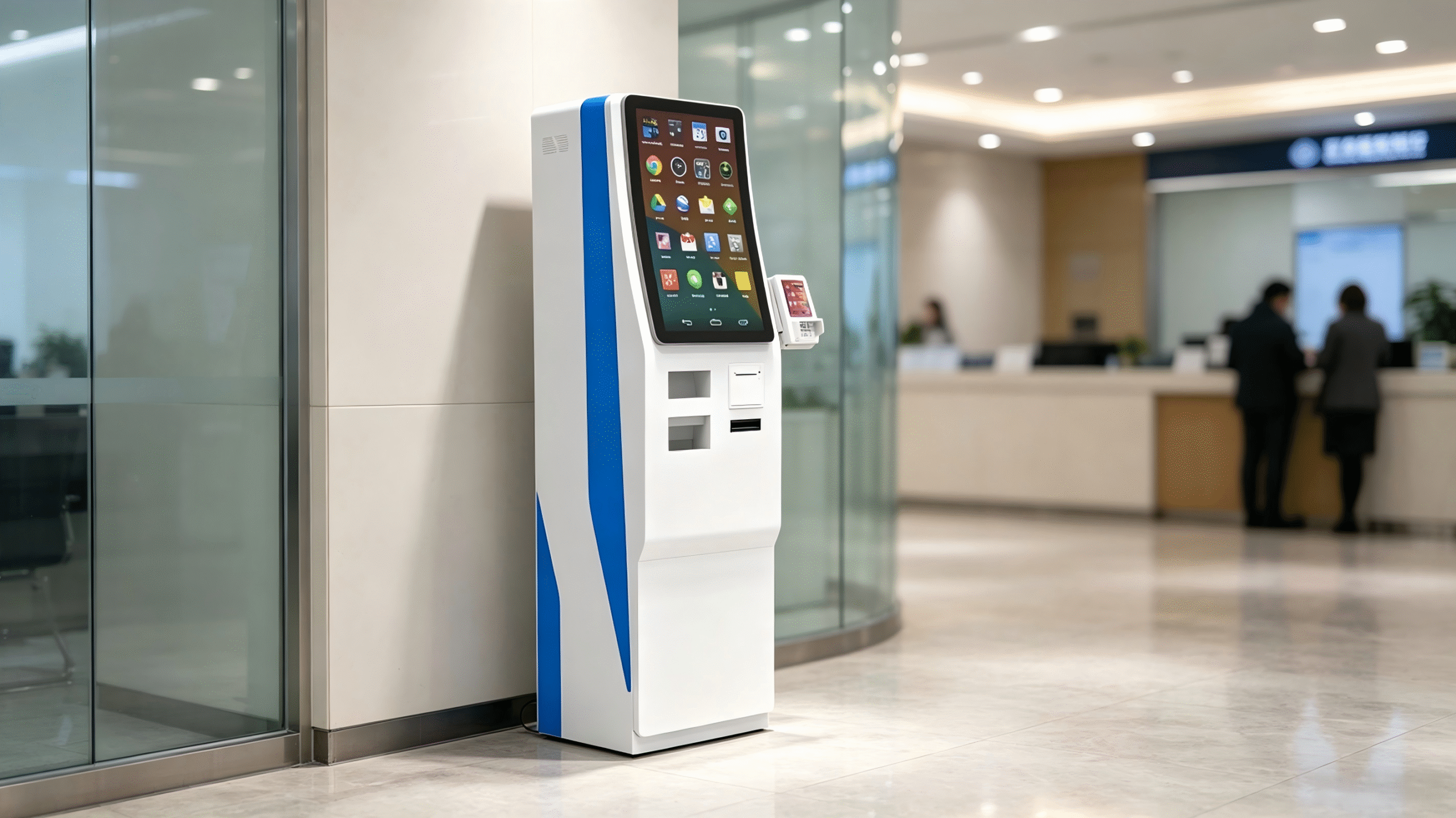
| Right-size the footprint | Tabletop vs floor-standing vs wall-mount cabinet | Room layout often decides the form factor before the electronics | CAD drawings + footprint dimensions |
| Ship compliant | CE / FCC / UL and electrical safety standard references | Determines which markets the unit can legally be deployed in | Declaration of Conformity + test reports |
| Scale across sites | OEM/ODM configurability: branding, peripherals, spare parts | Rolling out 40 cribs with one supplier beats 40 one-off builds | Config sheet + spare-parts list |
Compliance differs by market — lead with the right one
Where you deploy changes the certification conversation, and this is where most RFP responses go vague:
- EU / UK: Expect a CE-marking path — electrical safety (Low Voltage Directive 2014/35/EU and the applicable EN/HD standards), EMC (Directive 2014/30/EU), and, for machines, the Machinery Directive 2006/42/EC — note the incoming Machinery Regulation (EU) 2023/1230 has a transition that applies from 20 January 2027. Confirm the exact route with your supplier’s notified body, as applicability depends on the finished configuration.
- US / Canada: UL or equivalent listing and FCC compliance for any radio (RFID) module. RFID frequency rules (FCC Part 15) differ from European ETSI bands — a reader legal in one region may not be in the other.
- SEA / price-led projects: Certification scope and MOQ usually decide the winner. Ask for a per-site landed-cost breakdown and lead time, not just unit price, and confirm whether the reader band is approved locally.
- MENA: Add local-market conformity and localization to the spec early. Concretely, pin three things: the mains voltage and plug standard for the deployment country, the required interface language (and whether right-to-left rendering is needed), and the import/conformity route the buyer’s customs authority accepts — for example a GCC conformity route for Gulf states or SASO for Saudi Arabia. Retrofitting any of these later resets the whole build.
The three risks that sink a tool-checkout project
- Reader-band mismatch. RFID modules are region-specific. Confirm the approved frequency band for every deployment country before tooling. Changing this after build invalidates radio certification.
- Integration fantasy. “It has an API” is not the same as “it writes back to your CMMS.” Demand a documented integration path and, ideally, a pilot with your actual system before the full rollout.
- Spec-drift on enclosure. Factory-floor units get specced in an office and destroyed in production. Match IP rating to the real environment — a warehouse rack aisle and a machine-tool coolant zone are not the same duty.
All three risks share one root cause: the spec was written before the deployment environment was. Fix the reader band, the integration path and the IP rating on paper first — certification and rollout then follow from a fixed spec instead of chasing it. For how credentialing and per-transaction control interact with payment and identity hardware, our guide to payment hardware choices in a custom kiosk covers the wider peripheral set, and the EAA & ADA certification checklist covers the accessibility obligations you inherit once the kiosk is public-facing.
FAQ
Do I need RFID or is barcode enough? Barcode is cheaper and fine for low-volume, serialized assets. RFID wins when you issue kits or tool sets and speed per transaction matters — it reads multiple tags without line-of-sight.
Can the kiosk issue PPE and calibrated instruments too? Yes. The hardware is application-agnostic; what changes is the software rule (expiry dates, calibration intervals, recall lists). Confirm the software supports date-based rules, not just issue/return.
What IP rating should I specify? IP54 is typically adequate for dry, dust-exposed industrial areas. Specify higher (e.g. IP65) only where wash-down or heavy coolant exposure actually exists — over-speccing raises cost and can complicate service access.
Is an automated tool checkout kiosk considered machinery under EU rules? Start with one test: does the finished unit contain a powered, moving functional part that a person can be exposed to? A purely electronic cabinet — reader, electronic lock, screen, no driven movement — normally falls outside the Machinery Directive 2006/42/EC and is assessed under the electrical-safety and EMC directives instead. Add a powered actuator, lift or rotating mechanism and the machinery route usually applies. Because the answer turns on the final configuration rather than the product category, confirm the classification and the applicable directives with your supplier and their notified body before ordering.
Next step: get your spec on paper before you compare quotes
The cheapest mistake to avoid is comparing suppliers before you have fixed your own specs. Bring us your environment (indoor/outdoor, dust, wash-down), your identification method, and your CMMS/EAM integration requirement, and we will map them to a configurable enclosure and peripheral set.
Usingwin builds OEM/ODM-ready self-service and cash-handling kiosks with configurable enclosures, peripherals and branding. To move forward, request a specification review or a sample datasheet for your tool-crib project, and browse our OEM/ODM floor-standing and tabletop kiosk platforms to see the hardware baseline your spec will attach to.
Standards references above are cited as general orientation only. Certification applicability and the correct conformity route depend on the final configuration and deployment country — verify with a notified body or your supplier’s compliance team before ordering.