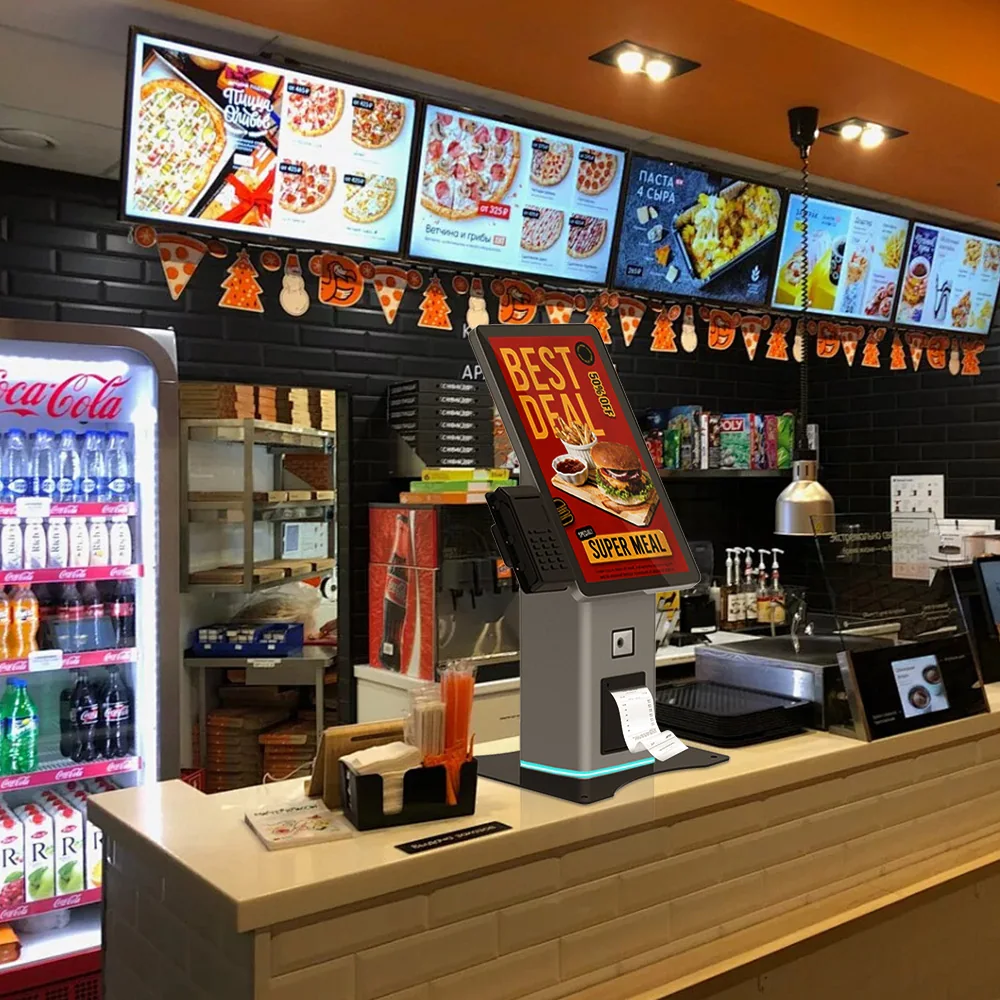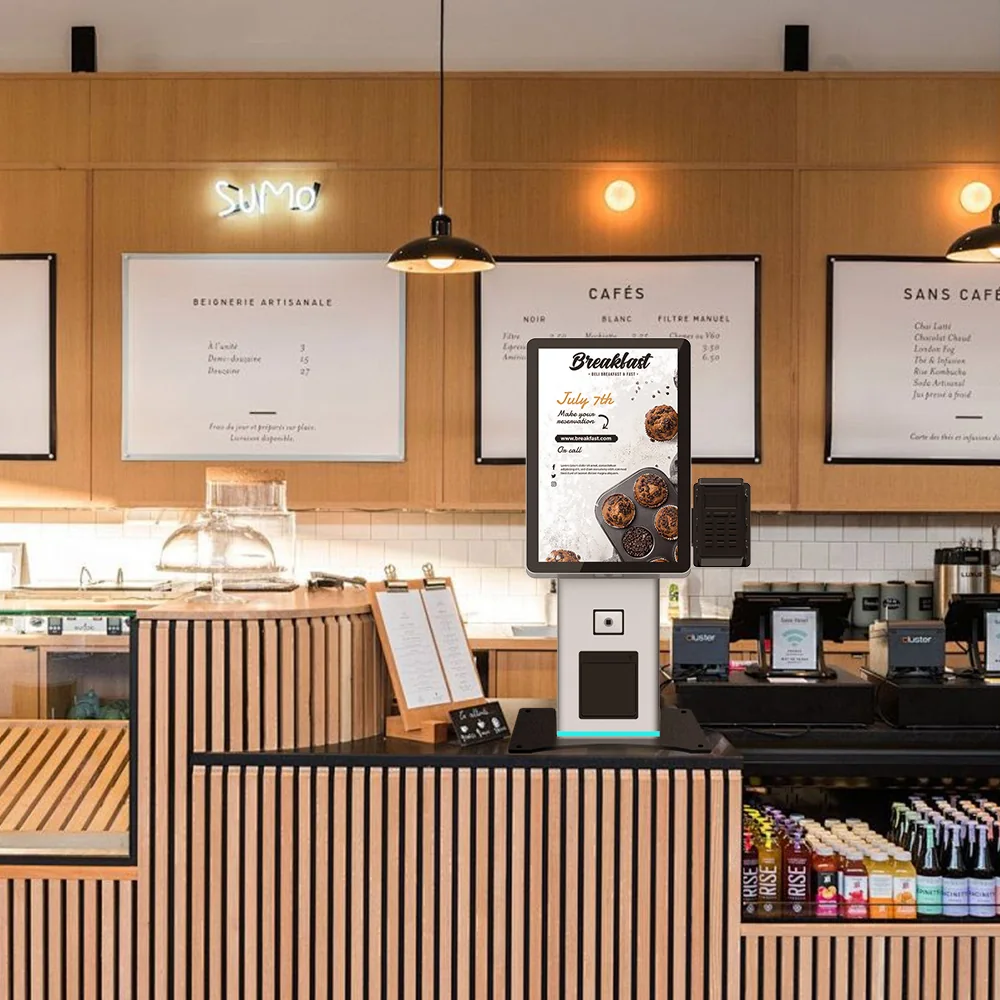
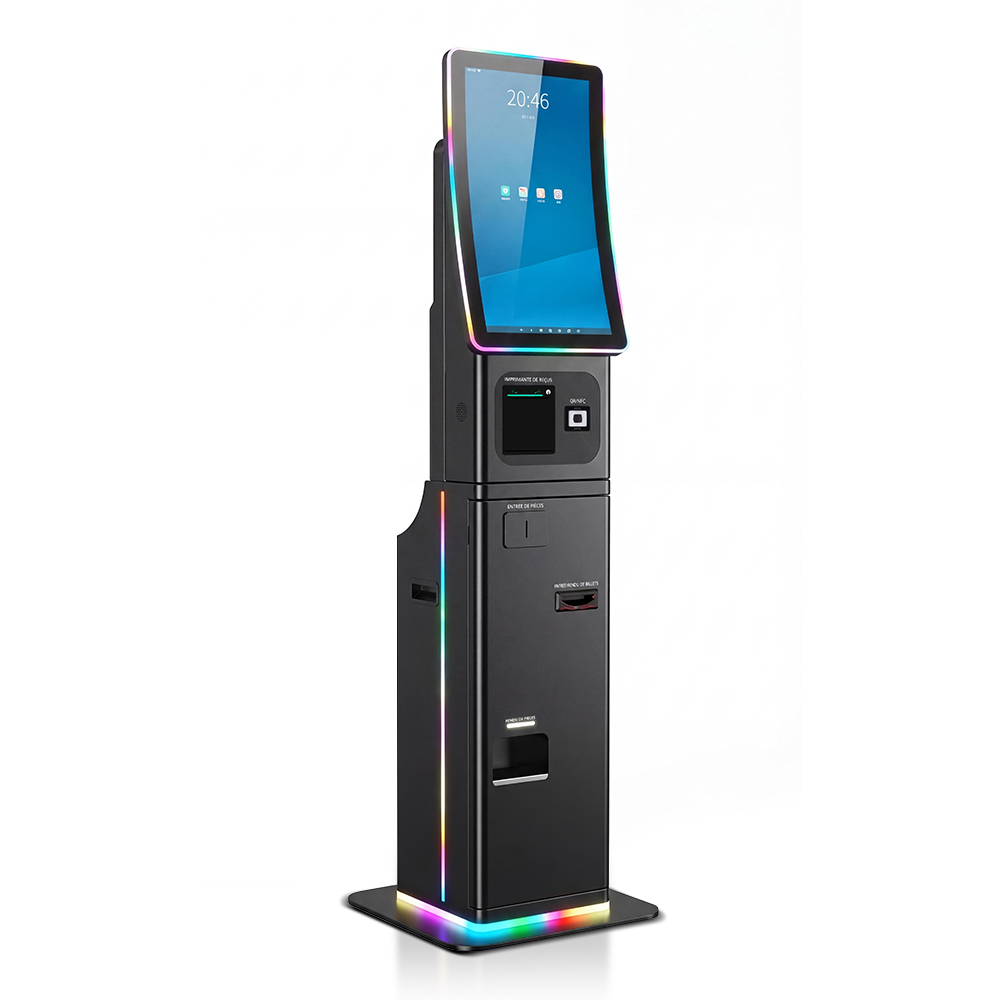
Quick answer: The short answer: choose a countertop kiosk when an existing counter can physically carry the terminal and staff can reach the cash module from the front; choose a wall-mounted kiosk when counter area must stay clear and the wall has the backing, the power/data path and the service clearance your selected cash module needs. There is no universal winner. Wall substrate, cash module service access and local code can each override footprint, which is why the mount decision should be made from the cash module service envelope outward — not from a floor plan sketch inward.
The short answer: choose a countertop kiosk when an existing counter can physically carry the terminal and staff can reach the cash module from the front; choose a wall-mounted kiosk when counter area must stay clear and the wall has the backing, the power/data path and the service clearance your selected cash module needs. There is no universal winner. Wall substrate, cash module service access and local code can each override footprint, which is why the mount decision should be made from the cash module service envelope outward — not from a floor plan sketch inward.
The mount choice is not a footprint contest. It changes three engineering facts: whether the cash module can be opened, cleared and emptied by staff standing where they actually stand; how the power, data and grounding path is built; and what structure has to carry a cantilevered load. Countertop versus wall-mounted is therefore a service-and-structure comparison before it is a space comparison.
Compact venues tend to fail at the same point regardless of format: the cash module service envelope was never checked against the mounting format. The unit fits the counter or the wall, but the acceptor door, cashbox removal path or jam-clearance space does not fit the room around it. The four constraints below are the ones that decide it.
Four constraints that decide countertop vs wall-mounted
Score both formats against your real counter depth, wall type and cash pickup route. The table lists what to request in writing for each row — a datasheet claim is not a drawing.
| Constraint | Countertop implications | Wall-mounted implications | Document to request |
|---|---|---|---|
| Cash module fit and service access | Module depth, service-door swing and cashbox pull-out must clear the counter overhang and any back-panel; front access is usually natural because staff stand beside the unit. | Service access is the first failure point: confirm the module opens from the front, or that staff can clear a jam without lifting the terminal off the bracket. | Cash acceptor/recycler service envelope drawing with cashbox removal path dimensions. |
| Cable, power and data routing | Often uses an existing counter grommet or back-panel cut-out, but still needs a service loop and strain relief so the cable is not loaded when the unit is moved for cleaning. | Requires concealed conduit or surface raceway at the correct height; power, data and grounding positions must be fixed before the wall is finished. | Cable exit coordinates and a conduit/raceway height drawing. |
| Mounting load and substrate | Host counter carries the dead load and any lean load; counter construction and fixing method must be confirmed. | The bracket transfers the full cantilevered load into wall studs or backing, so the bracket rating alone is not enough — the wall assembly must be checked. | Wall bracket load calculation plus counter fixing detail and cut-out drawing. |
| Accessibility and circulation path | The host counter governs reach and knee clearance, so kiosk height has to be coordinated with the counter it lands on rather than selected in isolation. | Installed projection into the customer path is the risk; confirm the projection and the clear width remaining beside it. | Reach and clearance drawing showing installed projection and operating height. |
Cash module fit: where wall-mounted layouts fail first
Do not use display size as a proxy for the cash module envelope. A compact wall unit with a large screen can still have a shallow cavity that forces the acceptor to sit closer to the wall than the note path allows, and the service door then fouls the bracket or the trim. Measure three things independently: the depth of the acceptor, recycler or hopper body; the swing or slide clearance of the service door; and the removal path of the cashbox including the hand and wrist space the operator needs.
Wall-mounted fabrication guidance from Atlas Manufacturing is blunt about the load path: the mounting bracket transfers the full cantilevered load into wall studs or backing ( Atlas Manufacturing ). That matters for the cash module because cash hardware is dense. A recycler stack adds mass low and forward in the enclosure, which is exactly where a cantilever amplifies it. Ask for the load calculation, then ask whether it was run against your wall build-up — masonry, stud partition with sheathing, or a caged partition behind a service counter are different answers.
For casino cages and convenience retail, add one requirement to the RFQ: a front-service cash module, or written confirmation that staff can open the module, clear a jam and remove the cashbox without detaching the terminal from the wall. If the only access is from the rear, the wall position you chose for space reasons now depends on whatever sits behind it — a queue, a stockroom, or a security door that cannot be propped open during a shift change.
Service access and uptime: can staff clear a jam without removing the terminal?
Run the maintenance route before you run the sales pitch. The task list is short and it exposes the mount decision quickly: unlock and open the cash module; remove the cashbox; clear a note jam in the transport path; replace printer paper; reboot the terminal; reach the security lock.
Countertop units usually give lift-out or swing-away access, which is convenient but requires counter space on the service side. Wall-mounted units can be better for the customer side and worse for the technician — rear-service wall units get blocked by counters, queues or cage security procedure. Photograph the maintenance route at the actual location, standing where the person clearing the jam will stand, and include the counter overhang and wall substrate in the frame. A route that requires moving a queue barrier or stepping into a customer lane is a design defect, not a training issue.
Ask for the lock hierarchy and key-management plan in writing, especially where cash pickup and technical service are handled by different staff. Two separate access levels — cashbox access versus full service access — prevent the common situation where the person who clears jams also controls the cash.
Mounting load, wall substrate and protrusion limits
For wall installations, the same Atlas guidance flags a second check: the assembly still has to respect the 4-inch protrusion limit where it sits in a circulation path ( Atlas Manufacturing ). Treat that as fabrication guidance to verify against your own site, not as a rule that applies unchanged in every US or EU jurisdiction — accessibility, fire-egress and circulation-path requirements are local, and the reviewer who signs off your fit-out decides the applicable number.
For countertop units, the equivalent coordination is height: because the host counter governs reach and knee clearance, the kiosk height has to be set against the counter it lands on. A counter designed for standing service and a counter designed for seated access produce different operating heights from the same terminal.
Space and cost claims: what to verify before you trust a 30% saving
A vendor comparison states that a wall-mounted touch screen kiosk generally frees up to 30% more space than a freestanding or countertop model ( Tabin ). Treat that as a vendor claim, not an independent measurement: the source does not report the test conditions, the baseline configuration or how space was measured, so it cannot be transferred to your site. The same source notes that countertop kiosks are cheaper for small firms and pilot rollouts — again a rollout-cost claim to verify, because a wall installation adds backing, conduit and service-access work that a countertop pilot may avoid.
Calculate your own installed footprint instead of borrowing a percentage:
- Countertop: counter depth used by the unit, plus the cash pickup and jam-clearance zone on the staff side, plus any lost serving area.
- Wall-mounted: installed projection from the wall face, plus the clear width remaining beside it for the customer path, plus the service clearance the cash module needs.
The comparison that matters is measured at your site, with your cash module, not at a trade show.
A 10-question RFQ checklist for your counter or wall layout
- Dimension drawing of the enclosure with the cash module installed, not empty.
- Cash module service envelope, including door swing and cashbox removal path.
- Wall bracket load calculation, stated against a named wall build-up.
- Counter fixing detail and cut-out drawing.
- Cable exit coordinates, conduit height and grounding point.
- Lock hierarchy and key-management plan separating cash access from service access.
- Reach and clearance drawing with installed projection and operating height.
- Surface finish and cleaning specification for the intended environment.
- Sample fit test: one unit, your cash module, your counter or wall, your staff performing the jam-clear route.
- Spare-parts list and the module-level compliance documentation for the configuration quoted.
Three of those are deal-breakers. Can the cash module be serviced from the front? What wall substrate is required, and has the load path been checked against the actual build-up? What is the installed projection into the customer path? If a supplier cannot answer all three in writing, the mount comparison is not finished.
Next step: send your counter or wall dimensions
Send the counter depth and overhang, the wall type and stud spacing, the cash module type with its service side, the power and data locations, and a photograph of the intended location taken from where staff will stand. Those five inputs are enough for a supplier to produce a dimension drawing that shows the service envelope in place rather than an enclosure in isolation.
Request dimension drawings and a quote for your counter or wall layout. Include the cash module model, the service side you need and your accessibility or circulation constraints; the drawing set should come back with the service envelope, load path and cable coordinates marked, so the mount decision can be signed off before fabrication.
Application note: check-in counters and casino cages are not the same cash problem
At a check-in counter, the binding constraint is usually counter area and staff reach, and a compact countertop unit frequently wins because the queue is already organised around the counter. In a casino cage, the binding constraints are cash security, lock hierarchy and front-service access, so a wall-mounted unit only works if the service side stays clear during operating hours and the access levels are genuinely separated. Convenience retail sits between the two: tight counter space pushes the decision toward the wall, while staff workflow usually pushes it back toward the counter.
FAQ
Can a wall-mounted kiosk handle a cash recycler?
It can, if the recycler's service envelope and load path both fit the wall assembly. Cash hardware is dense and sits forward in the enclosure, so the cantilever load calculation has to be run with the module installed. Ask for the drawing with the module fitted, and confirm the cashbox and jam-clear path work from the front.
Do wall-mounted kiosks need a backing plate or wall reinforcement?
Assume the wall must be checked, not just the bracket. The bracket transfers the full cantilevered load into studs or backing, so the requirement depends on your wall build-up. Get the load calculation stated against a named substrate and have it reviewed by whoever is responsible for the wall structure.
Is a countertop kiosk cheaper than a wall-mounted kiosk for a pilot?
Often, but verify rather than assume. A published vendor claim says countertop units are cheaper and less costly to roll out, particularly for pilots — that is a supplier claim, not a measured comparison. Price the wall option with backing, conduit, grounding and service-access work included before comparing totals.
How much service clearance does a countertop cash kiosk need?
Enough for the cashbox removal path plus the operator's hand and wrist space, measured with the service door open. That figure must come from the cash module service envelope drawing for your specific acceptor or recycler, then be checked against the counter overhang and the space behind the counter — not guessed from the enclosure footprint.