Quick answer: Compare airport, casino, stadium duty cycles to size cash box capacity, choose note recycler vs bin, set cassette swap intervals. Get sizing worksheet.
Overview
Duty cycle is the single input that decides whether an unattended cash handling kiosk performs well or becomes a service problem: transactions per hour × peak factor × operating hours gives you notes per hour, and that number drives required cash box capacity, cassette swap interval, and labor cost. It also decides whether a note recycler or a large-capacity bin is the correct configuration — a cash recycling kiosk only earns its cost when the venue actually needs notes paid back out at volume. The limitation worth stating up front: there is no universal capacity recommendation. An airport, a casino, and a stadium can run the same kiosk chassis and need three different cash modules. Every capacity and throughput figure below is either an input you supply or an assumption you must verify on your own note mix before you shortlist.
Most vendor comparisons stop at listing cassette sizes. That is the wrong starting point. The useful comparison is derived: take your own transaction data, run it through the formula, and see which configuration survives your worst hour.
Why Duty Cycle Determines Cash Box Capacity
The three venue types differ less in total daily volume than in shape :
- Airport — steady, modest transactions per hour, continuous 24/7 operation. Swap interval is driven by elapsed time, not by a peak event.
- Casino — continuous operation plus sharp gaming peaks and heavier cash-out or redemption flow. Note outflow can be as important as note intake, which is where recycling enters the decision.
- Stadium — near-zero traffic on non-event days, then a dense burst of transactions inside a short ingress or concession window. Peak factor, not the annual average, sets the requirement.
That difference changes four purchase decisions: how large the usable cassette capacity must be, whether you buy a note recycler or a plain bin, how often staff must swap cassettes, and what each swap costs in labor and downtime. A configuration sized for an airport’s hourly rate will fail on a stadium event day. A configuration sized for a stadium burst will be oversized and under-utilized in a 24/7 airport concourse.
No figure in this article is a tested result. Treat them as a structure for your own inputs.
The Sizing Formula Buyers Should Run
Run this chain in order, using your own numbers at every step:
- Transactions per hour (average and peak) — from your POS or access logs, not a vendor estimate.
- Notes accepted per hour = transactions/hour × share of transactions paid in cash × average notes per transaction.
- Notes per day or per event = notes/hour × operating hours (or burst duration).
- Required usable cassette capacity = notes per peak period × safety buffer you choose. Use usable capacity, not gross box volume — a full cassette that jams at 90% is a 90% cassette.
- Cassette swap interval = usable capacity ÷ notes per hour at peak.
Input fields you must collect before shortlisting: average transaction value, note mix including width and condition, acceptor cassette capacity (confirmed by vendor sample, not a datasheet), peak factor, operating hours, and realistic staff minutes per swap including escort and reconciliation.
Two cautions. First, do not accept a vendor’s MTBF, jam rate, or capacity claim as a comparison criterion — ask for a third-party throughput or reliability report, and if none exists, run your own sample test on your own notes. Second, remember that a faster acceptor raises notes per hour and therefore shortens the swap interval unless bin capacity scales with it.
Airport Profile — Steady Baseline, 24/7 Duty Cycle
Airport cash-in is typically low transactions per hour sustained around the clock. The sizing pressure is duration, not intensity. If notes per hour are modest and staff are already on site for other duties, a single large-capacity bin with a scheduled daily or multi-day swap often beats a recycler — particularly where the kiosk accepts cash only and never pays it out.
Where an airport kiosk does need payout — currency exchange, refunds, or prepaid top-up — recycling changes the calculation because recycled notes reduce replenishment transport, but only if incoming note fitness supports reissue. That is a sample-level question, not a spec-sheet question.
Labor driver: swap frequency × minutes per swap × loaded rate, plus secure escort time if the cassette sits behind controlled access. In a 24/7 environment, downtime windows are also scarce, so swap time is a real constraint.
Verification step: pull a full week of hourly transaction counts, including overnight and red-eye hours, and identify the highest sustained hour before choosing capacity.
Casino Profile — 24/7 Plus Gaming Peak and Cash-Out Flow
Casinos combine a continuous baseline with pronounced peaks after shows, tournaments, or payout cycles. Critically, the cash flow is often bidirectional: notes come in at buy-in or top-up, and notes go out at cash-out, redemption, or ticket settlement.
This is the profile where a cash recycling kiosk most often justifies itself, because closed-loop recycling can reduce how often staff physically move notes to and from the cage. Whether it pays off depends on the ratio of payout to acceptance volume and on whether recycled notes stay fit enough to reissue — both of which vary by property.
Sizing rule: calculate from peak-hour notes, never from the daily average. A property can look comfortable on average and still need multiple swaps during a single peak evening. Gaming-floor deployments where the kiosk must match cabinet aesthetics and floor layout also constrain where a cassette can physically be sited, which feeds back into swap time — see the slot-game cabinet format for that environment.
Labor driver: frequent swaps, dual control, escort, and cage reconciliation. Compare recycler versus bin on total cost of ownership across a full peak cycle, not on purchase price alone.
Stadium Profile — Event-Day Burst, Extreme Peak Factor
Stadium duty cycle is almost entirely defined by the event. Outside event days, transaction volume approaches zero. On event day, thousands of notes can arrive inside a two-to-four hour window at ingress, concessions, or box office functions.
Size for the worst-case event, not the annual average. A mid-event swap is operationally unacceptable in most venues — the queue visibility alone makes it a non-starter — so the requirement is that usable capacity exceeds the entire burst, with a buffer.
Note direction matters here. If the kiosk is cash-in only (ticket upgrades, deposits, donations), a single large-capacity bin is usually the simpler and more defensible choice; a recycler adds capability you will not exercise. If the venue pays cash out — deposit return, refunds, or exchange functions — the calculus shifts toward recycling. The currency exchange kiosk format is built around that bidirectional case.
Labor driver: pre-event load, post-event swap, and event-day standby. By design, the swap interval equals the event length plus buffer.
Side-by-Side Comparison: Sizing Inputs
Fill this in with your own data. No cell is pre-filled with a vendor number because no such number is transferable between venues.
| Input / output | Airport | Casino | Stadium |
|---|---|---|---|
| Operating profile | 24/7 continuous | 24/7 + gaming peaks | Event-day burst |
| Transactions/hour (buyer input) | Low, flat | High with spikes | Near zero, then extreme |
| Peak factor (buyer input) | Low | Medium–high | Very high |
| Operating hours (buyer input) | 24 | 24 | Event window only |
| Notes/hour (calculated) | TPH × cash share × notes/transaction | Peak TPH × cash share × notes/transaction | Burst TPH × cash share × notes/transaction |
| Notes per day or event (calculated) | Notes/hour × 24 | Notes/hour × peak hours, plus payout notes | Notes/hour × burst length |
| Required usable box capacity (buyer input) | Set by time between swaps | Set by peak period | Set by full event burst |
| Swap interval (calculated) | Usable capacity ÷ notes/hour | Usable capacity ÷ peak notes/hour | ≈ event length + buffer |
| Recycler vs bin tendency | Bin unless payout required | Recycler often justified | Bin if cash-in only |
| Labor cost driver | Time-based swap schedule | Swap frequency + reconciliation | Pre- and post-event staffing |
Any vendor-supplied capacity figure must be re-tested against your note mix and your operating profile before it enters a shortlist scoring sheet. Use the table to compare configurations on your data, not to lock in a fixed product.
Note Recycler vs Large-Capacity Cash Bin
Four criteria decide this:
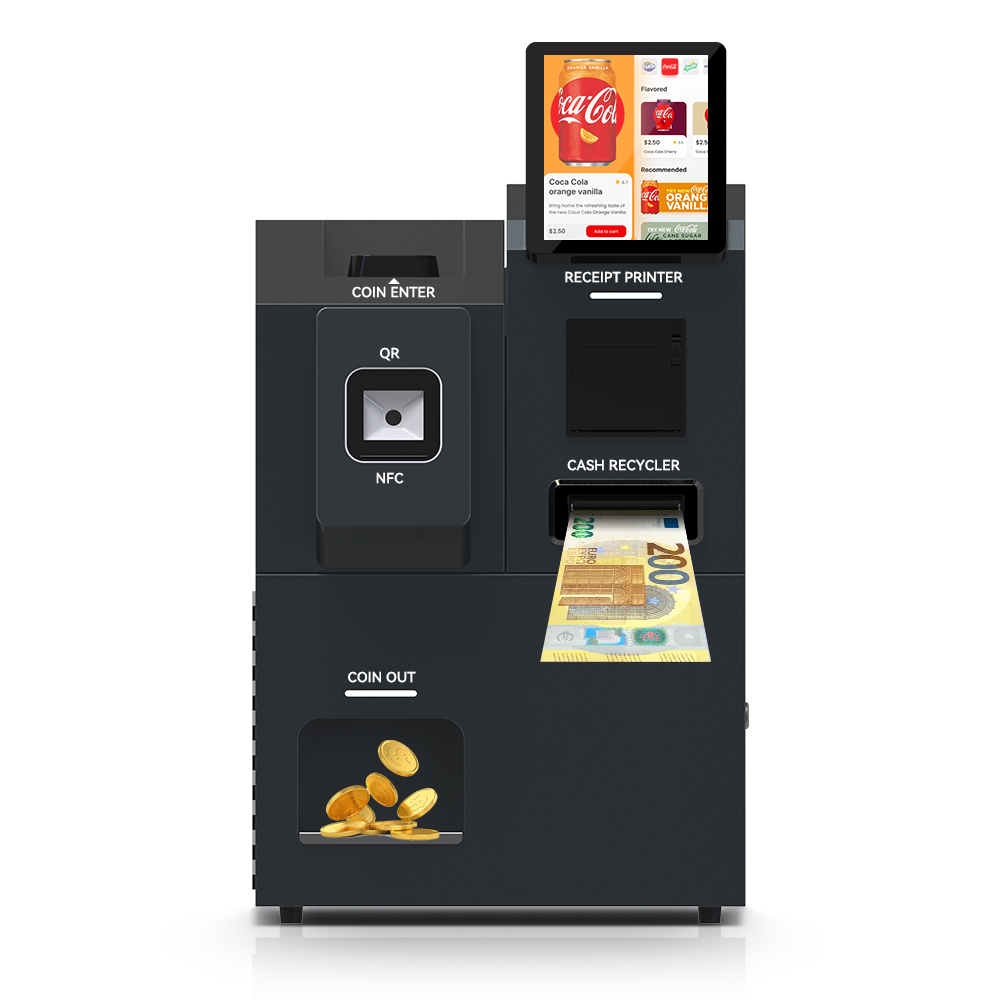
- Cash-out requirement — if the kiosk must dispense notes, a recycler replaces a separate dispenser and its own cassette.
- Note volume — recycling helps most where accept and payout volumes are both high and roughly balanced.
- Swap tolerance — recyclers typically hold less per cassette than a dedicated large bin, so they favor venues that can tolerate more frequent — but shorter and simpler — service visits.
- Labor cost per swap — in a secured venue, minutes per swap and escort requirements often dominate hardware cost.
Simple guidance: cash-out heavy, high throughput, staff able to service regularly → consider a note recycler. Cash-in only, burst-loaded, few service windows → consider a large-capacity bin. In all cases, recycler note paths and fitness thresholds must be verified with your actual note mix; recycled note condition varies by venue and cannot be assumed from a datasheet. The choice directly affects staff workload and venue self-service uptime.
Bill Acceptor and Peripheral Selection
The bill acceptor sets the practical ceiling on your duty cycle. Match these attributes to your peak notes per hour and note mix:
- Acceptance speed and the resulting notes per minute at peak.
- Supported note width and length range versus your actual currency mix.
- Cassette capacity, and how easily it is removed under real conditions.
- Validation and security approach, including any payment-component requirements relevant to card functions.
Buyer verification steps: request a sample test using your note mix, measure acceptance and jam behaviour yourself, and confirm cassette handling with the staff who will actually perform swaps — including reaching the unit inside its enclosure. Do not publish or rely on any acceptor MTBF or jam-rate figure without a third-party report or your own test.
Cassette Swap Cadence and Labor Math
Swap interval = usable cassette capacity ÷ notes per hour at peak. Labor cost = swaps per day × minutes per swap × loaded hourly labor rate.
The three profiles produce genuinely different cadences from the same hardware: an airport may swap on a schedule tied to shift patterns, a casino may swap more than once in a peak evening, and a stadium may swap once per event by design. Include the hidden labor — secure escort, dual control, reconciliation, and the fact that the kiosk is out of service while open — and validate swap time with actual staff before shortlisting. A vendor’s “swap in seconds” claim rarely includes walking, escort, and reconciliation.
Verification Steps Before You Shortlist
- Run a sample test with your own note mix to measure acceptance, note path behaviour, and true usable capacity.
- Request third-party throughput or reliability reports; treat any unverified figure as an assumption.
- Confirm payment-component compliance where card functions are present — the PCI Security Standards Council publishes the applicable standards. Note that cash box sizing and note handling are not covered by PCI DSS.
- Confirm the cassette swap procedure, security requirements, and spare-parts availability with each vendor.
- Re-run the sizing table with measured sample data before scoring the shortlist.
How do I calculate cash box capacity for a 24/7 unattended cash automation kiosk?
Multiply average transactions per hour by cash share and notes per transaction to get notes per hour, then multiply by the hours you want between swaps. That product is your required usable capacity, before any buffer. Confirm usable — not gross — cassette capacity with the vendor’s sample.
Is a note recycler worth it for a stadium kiosk with event-day only cash flow?
Usually not if the kiosk only takes cash in. A large-capacity bin sized for the full event burst is simpler and avoids recycler complexity you would never exercise. If the kiosk must pay notes out during the event, recycling becomes relevant and should be costed against extra staffing.
How often should cassettes be swapped in a casino cash handling kiosk?
Calculate from peak-hour notes, not the daily average, and divide usable capacity by that peak rate. If the result is less than one full peak shift, either the capacity or the service model needs to change.
What is the difference between a bill acceptor and a cash recycling kiosk?
A bill acceptor validates and stores incoming notes into a cassette. A cash recycling kiosk accepts notes, validates them, and can also dispense them back out from recycled stock — which is why its capacity and fitness logic are more demanding.
Next Step
Duty cycle — not a generic spec sheet — should set your cash box capacity, your recycler-versus-bin decision, and your swap cadence. Build the table with your own inputs, validate it on a sample, and only then compare vendors on equal terms.
Request the cash-handling sizing worksheet and a quote, and browse the freestanding cash-handling self-service kiosk configuration as your shortlist starting point.