Quick answer: Compare Android vs Windows kiosk TCO for multi-store retail rollout: batch imaging, remote fleet management, POS integration, MOQ, lead time. Request quote.
Overview
A chain-wide kiosk rollout usually fails on the same four line items: batch imaging labor, remote management tooling, OS patch cadence, and POS/peripheral integration validation. Neither Android nor Windows wins those four universally. Windows kiosks are the lower-risk choice when the fleet must run existing Windows POS, ERP or middleware stacks and vendor-supplied Windows peripheral drivers. Android kiosks are the lower-risk choice when enrollment and remote management are the dominant cost and you standardize on Android Enterprise with a supported EMM. The unit price difference between the two is rarely the deciding factor at 50+ stores — and the pilot store you already signed off cannot tell you which of these costs will dominate.
Why the pilot store can’t justify the fleet decision
A single-store pilot validates the customer experience, the screen and enclosure, and whether one payment or cash peripheral behaves. It does not validate any of the costs that scale:
- Batch imaging labor — one device configured by hand is a project; 200 devices configured by hand is a project plan.
- Remote management burden — one store can be visited. A fleet cannot.
- OS lifecycle and patch cadence — an unsupported OS on one kiosk is an annoyance; the same OS on a whole chain becomes a compliance question, particularly where payment card data is in scope.
- Integration re-validation — a POS middleware version that worked in the pilot must be re-validated per store cluster, not per chain.
This is where most published comparisons stop: they compare UX, hardware specs and general OS pros and cons. For a multi-store decision, those are settled already — they were settled in the pilot. What remains open is procurement: rollout cost drivers, vendor constraints, and the lifecycle commitment you can get in writing.
At fleet scale, compliance exposure is the dominant pain that reopens the OS question. Payment kiosks handling card data sit inside a cardholder data environment governed by PCI DSS; the OS version you standardize on, its secure-boot and patch posture, and how updates are coordinated with your payment provider all feed into that scope. The correct move is not to reason about it internally — it is to require your acquirer or QSA to confirm scope for the specific configuration, and to require the kiosk vendor to state the supported OS versions and patch path in the purchase agreement.
Fleet TCO comparison: the drivers that actually scale
The table below compares rollout cost drivers rather than features. Treat every row as a question to put to a vendor in writing — not as a fixed truth about either OS.
| Rollout cost driver | Windows kiosk | Android kiosk |
|---|---|---|
| Unit hardware and licensing | Varies by processor, memory, board and Windows edition; licensing is a separate line | Varies by SoC, memory and board; OS is typically supplied by the board vendor |
| Batch imaging method | Provisioning packages, imaging tooling and MDM-driven configuration; supports single-app and multi-app kiosk modes | Zero-touch, QR-code or Knox-style enrollment with managed app distribution and OEMConfig profiles |
| Remote management | Windows-capable MDM/UEM plus Group Policy-style configuration | Android Enterprise EMM with dedicated-device enrollment |
| OS and security update cadence | Depends on the servicing channel chosen (LTSC versus annual servicing) and the Microsoft support window for that edition | Depends on device model entering the vendor’s enterprise-recommended list and the OEM’s stated support window |
| POS / loyalty / ERP integration | Widest legacy driver and middleware compatibility; larger attack surface to lock down | Modern APIs, but peripheral SDK availability varies by vendor and cash module |
| Peripheral and cash-module support | Driver availability usually documented per peripheral model | Integration depends on the OEM/ODM supplying a maintained Android SDK |
| OEM-ODM configurability | Board, enclosure, branding and peripheral selection constrained by Windows driver availability | Board, enclosure, branding and peripheral selection constrained by Android BSP availability |
| Lifecycle commitment | Request the exact supported editions and end-of-servicing alignment | Request the exact OS versions and security-patch commitment per model |
Then separate the cost lines into one-time and recurring, because the two OS paths trade one against the other:
- One-time: hardware, imaging/build effort, integration validation per store cluster, installation labor, branding and enclosure tooling.
- Recurring: EMM/MDM licences per device, patch and regression testing effort, field support and swap logistics, cash module maintenance, application updates coordinated with your POS vendor.
A vendor-supplied TCO calculator is only useful if it is parameterized on your actual store count, device count per store, peripheral list and support term. Ask for it built on those inputs rather than accepting a per-unit figure — per-unit pricing varies with configuration, so no meaningful fleet number exists without a configured bill of materials.
Windows path
Windows kiosk deployment can be driven by provisioning packages and централized configuration tooling, with the OS itself supporting single-app and multi-app kiosk modes documented by Microsoft (see Microsoft Learn: Windows kiosk configuration options ). For a fleet, the practical model is: build a reference image or provisioning package, enroll devices into your UEM, and let configuration and policy be pushed rather than touched. Choose the servicing channel deliberately, because it determines how often the fleet changes underneath your validated application.
Android path
Android kiosk deployment typically runs on dedicated-device enrollment: zero-touch enrollment, QR-code provisioning or Knox-style enrollment, with apps distributed from managed Google Play or as privately hosted APKs and device settings applied through OEMConfig profiles. The overhead shifts from imaging to enrollment entitlement and EMM configuration — cheap and fast if the device model is enrolled in the right program, expensive and manual if it is not.
Field failure points to plan for
- Network variance between stores — enrollment and image pulls stall on slow or filtered links. Pre-stage images locally or plan for resumable downloads.
- Peripheral driver or firmware version drift — payment terminals, scanners and cash modules may ship in different revisions across batches. Lock versions per batch and record them.
- Unvalidated update arrival — an OS update that lands mid-rollout can invalidate a signed-off app build. Control update rings and stage them.
- Staged rollout checkpoints — rollout in waves with defined go/no-go criteria; do not compress waves because the first stores went smoothly.
Require these remote fleet capabilities before you commit, on either OS: remote lock and wipe, scheduled and on-demand app push, device grouping by store cluster, peripheral health and status reporting, cash module status and reconciliation reporting, remote configuration change with audit log, and a documented offline behaviour if the store loses connectivity.
POS, loyalty and ERP integration risk per OS
Windows is usually the shorter path where legacy POS middleware, .NET services or vendor-supplied Windows drivers already exist and are supported — at the cost of a larger surface to lock down in kiosk mode. Android usually offers cleaner modern APIs and tighter lockdown, but integration risk concentrates in peripheral SDK availability: if the payment terminal or cash recycler vendor does not maintain an Android SDK, that peripheral can force the OS decision on its own.
Put these questions in writing before shortlisting:
- Does the OS support your POS middleware version, and who has validated that combination?
- Are the peripheral drivers or SDKs signed, versioned and maintained, and by whom?
- How are OS updates coordinated with the POS application vendor’s own release schedule?
- For payment configurations, how is card data kept out of scope — tokenization, point-to-point encryption, secure boot, and restricted kiosk mode?
PCI DSS scope is a framework question, not a product claim: confirm with your acquirer or QSA which requirements apply to your specific kiosk configuration, and confirm that the kiosk vendor’s compliance documentation covers the exact model you are buying, not a factory-level certificate alone.
OS lifecycle and security-update burden
The OS you standardize on determines who patches what, how often, and what happens when the version you built on goes out of support. On Windows, the burden is selecting a servicing channel and tracking the Microsoft support window for that edition. On Android, the burden is choosing device models that carry a defined enterprise support window and confirming the OEM will ship security patches for the term you need.
At fleet scale, that becomes an operational cost, not a technical detail: every unpatched device is applied risk and audit exposure. Require a written lifecycle commitment covering supported OS versions, patch cadence, notification lead time for end-of-support, and what the vendor will do if your chosen version reaches end of life mid-deployment.
OEM-ODM configurability: MOQ, lead time, cash modules and branding
OS choice constrains what a manufacturer can configure. Windows availability affects board and peripheral selection; Android availability depends on the board support package route the OEM/ODM maintains. Cash-accepting and cash-recycling modules are the most common constraint, because their integration depends on the module vendor’s SDK for the chosen platform.
Get these in writing, because they change the economics more than the OS does:
- Minimum order quantity per configuration — a branded enclosure is a different MOQ conversation from a standard one.
- Lead time from purchase order to first delivery, and lead time for repeat batches.
- Warranty term and what it covers, return policy and RMA process, and who pays return freight.
- Spare parts availability for the support term you are committing to.
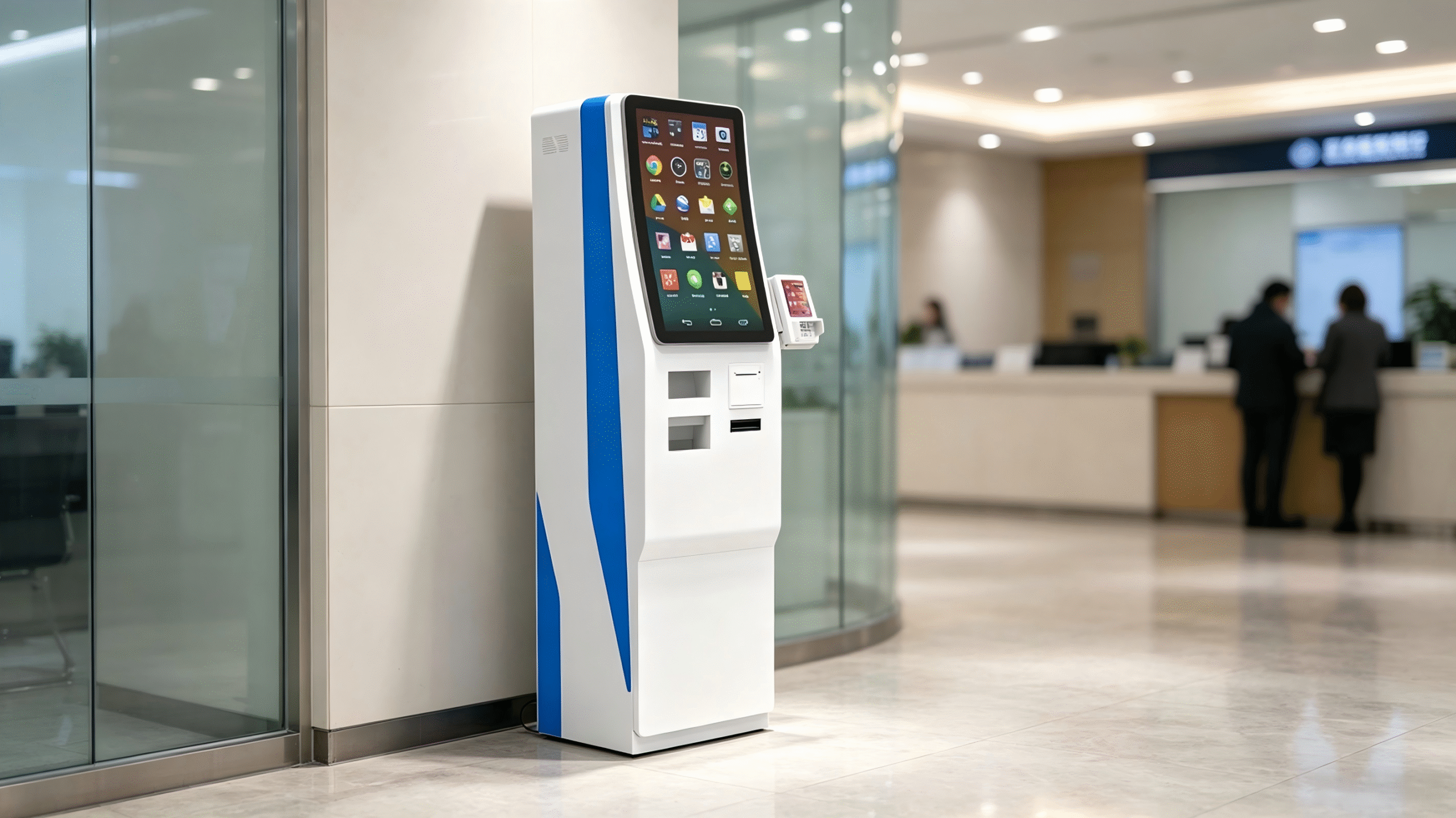
Note that total cost depends on configuration and that pilot results may not scale linearly — a pilot with one peripheral set and reliable store networking is not a representative sample of a chain. A configurable platform such as a freestanding cash-handling self-service kiosk or a small-footprint tabletop kiosk for counter formats lets you standardize the OS across formats while varying the enclosure — useful when your store formats differ but your IT standard should not.
Decision checklist: 7 questions before you commit one OS chain-wide
- What is the five-year TCO per store, itemized into hardware, imaging, management licences, support and integration — not a single blended number?
- What is the exact batch imaging or enrollment method, and how many devices can be provisioned per day per technician?
- What remote fleet management is included versus licensed separately, and which store-level actions can be performed without a site visit?
- What is the written OS lifecycle commitment — supported versions, patch cadence and end-of-support notice period?
- Has the POS/loyalty/ERP integration been validated against your actual versions, and by whom, in writing?
- What are the MOQ, lead time, warranty and return terms for the configured model, including the cash module?
- What is the fallback plan if the chosen OS version reaches end of life mid-rollout, or if a required peripheral loses SDK support?
If you want an external sanity check on vendor answers, a supplier-vetting framework such as these 12 questions to ask a kiosk supplier before signing maps closely onto the procurement risks above, even though it was written for hospitality deployments.
When a mixed OS fleet is rational — and when it’s a trap
A mixed fleet is defensible in narrow cases: a store cluster with a hard legacy integration constraint that Android peripheral SDKs cannot serve, or a regulatory or client requirement that mandates a specific platform. It is a trap when it exists only because different regions or teams bought independently — you inherit two patch pipelines, two imaging processes, two sets of integration validation, and two support paths, for no functional gain.
Decision rule: standardize on one OS unless a specific store cluster has a documented integration or regulatory constraint that the other OS cannot satisfy. If you must diverge, confine the exception to the smallest possible cluster and assign the same lifecycle commitment to both.
Next step
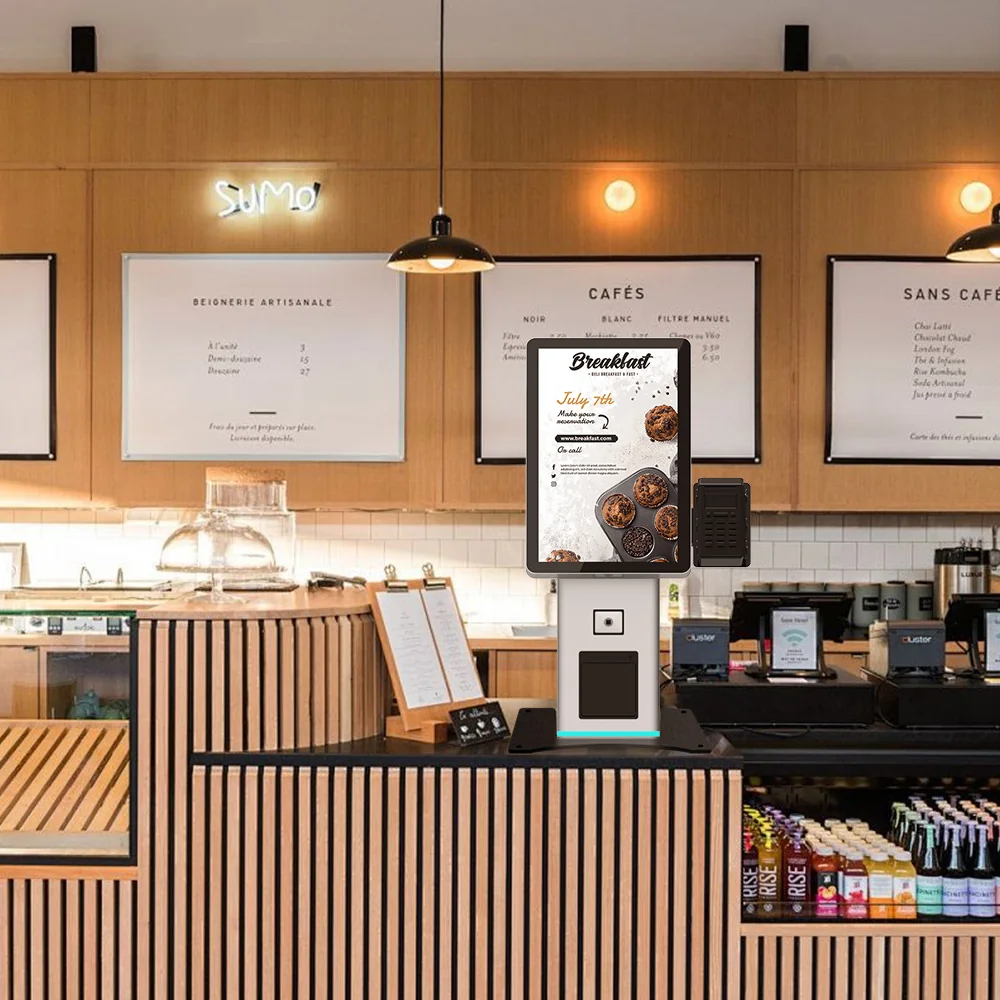
Request a quote, sample unit, and spec sheet, plus a multi-store fleet deployment plan. A usable reply should include the configured bill of materials per store format, the enrollment or imaging method proposed for your store count, the written OS lifecycle commitment, MOQ and lead time, and warranty and return terms. Use the wall-mount self-service kiosk platform as the starting configuration for a standard-store rollout, and ask for the fleet deployment plan to be built against your actual store count rather than a generic per-unit price.
Is Android or Windows better for multi-store retail kiosk deployment?
Windows is generally lower risk when the fleet must run existing Windows POS, ERP or middleware and vendor-supplied Windows drivers. Android is generally lower risk when enrollment and remote management dominate the cost and you standardize on Android Enterprise with a supported EMM. The deciding factor is usually peripheral SDK availability and your integration stack, not the OS user experience.
How do you deploy kiosk images to 100+ stores?
On Windows, through provisioning packages or a reference image combined with MDM-driven configuration and staged update rings. On Android, through zero-touch, QR-code or Knox-style enrollment into an EMM, with apps from managed Google Play or private APKs. In both cases, rollout in waves with defined checkpoints, and control OS updates so they do not land mid-wave.
Can Android kiosks integrate with legacy POS systems?
Sometimes. The limiting factor is whether the POS middleware and each peripheral — particularly payment terminals and cash modules — have maintained Android SDKs. If a required peripheral has no Android SDK, that constraint usually decides the OS for you.
What is the MOQ and lead time for custom retail kiosks?
Both depend on configuration, enclosure tooling, branding and the peripheral set, so they must be quoted per project rather than assumed. Ask for MOQ, first-batch lead time and repeat-batch lead time in the written quotation, along with warranty and return terms.
How do you manage OS security updates across a kiosk fleet?
Control the update channel centrally, stage updates in waves, and validate against your signed-off application build before broad release. Require the vendor to commit in writing to supported OS versions, patch cadence and end-of-support notification.
What does a multi-store kiosk TCO include?
One-time items — hardware, imaging, integration validation, installation and branding. Recurring items — EMM/MDM licences, patch and regression testing, field support and swap logistics, cash module maintenance, and application updates coordinated with your POS vendor. A per-unit hardware price alone is not a fleet TCO.