Quick answer: A buyer-side checklist for sourcing hotel check-in kiosk hardware: the 12 questions that separate an OEM that can carry your lobby rollout from one that hands the risk back to you.
Quick answer
Vetting a hotel check-in kiosk supplier comes down to four gates: PMS integration depth, accessibility and payment compliance, enclosure and module engineering, and commercial terms (MOQ, lead time, spares). Ask for a named PMS integration list, the actual certificates behind EN 301 549 / ADA / PCI DSS claims, the module bill of materials, and a written lead time with a spares commitment. A supplier that cannot produce these before contract is transferring their rollout risk onto your property.
Why this decision is getting harder, not easier
Hotel self-check-in kiosks have moved from a novelty to a platform. The 2026 market sizing puts the global hotel self check-in & check-out kiosk segment at roughly USD 2.57 billion in 2026, growing to about USD 4.98 billion by 2032 (CAGR above 11%) — and the product definition has widened from “check-in/check-out” to payments, identity verification and upsell modules on the same cabinet.
That shift moves the risk profile. When a kiosk only printed a folio, a mediocre supplier was an inconvenience. When it encodes room keys, authorizes cards and reads passports, a mediocre supplier is a compliance event.
Two deadlines make 2026 the wrong year to buy on price alone:
- EU: the European Accessibility Act has covered self-service terminals since mid-2025, with market-access style enforcement; the technical baseline is EN 301 549 V3.2.1 .
- US: the DOJ’s April 26, 2026 deadline pushed public-facing digital services to WCAG 2.1 AA ; combined with ADA Standards for Accessible Design, any kiosk acting as a public service interface inherits the expectation.
Neither is a hardware-only problem — but both are decided by hardware choices (reach range, keypad height, audio jack, screen contrast) that you cannot retrofit economically after the lobby is built.
Gate 1 — Integration (questions 1–3)
- Which PMS platforms do you integrate with, by name and version? Ask for a written list, not “all major PMS.” Then separate native integrations from middleware-brokered ones — middleware adds a vendor, a contract and a failure point.
- What happens when the PMS is unreachable? A kiosk that fails closed (guest waits) and one that fails open (guest checked in, folio not written) are radically different operational risks. Ask for the documented degraded mode.
- Can it read OTA bookings, direct bookings and walk-ins? If the kiosk only serves one of the three, front desk staff will keep a manual lane open — and you will not realize the labor saving you modelled.
Gate 2 — Compliance (questions 4–6)
- Which parts of PCI DSS scope does the kiosk sit inside? P2PE, tokenized pin-pads and “we don’t store cards” are three different answers with three different audit burdens. Get the payment architecture in writing.
- How does the kiosk meet EN 301 549 / ADA in physical terms? Reach range, operable controls, audio output for visually impaired guests, screen height. Ask for the accessibility conformance documentation, not a marketing page.
- Where does guest personal data live, and for how long? Passport and ID scanning pushes you into GDPR-territory retention questions. Ask for the data flow: on-device, on-property, or vendor cloud.
Gate 3 — Engineering (questions 7–9)
- Who owns the enclosure design, and is it OEM/ODM or rebadged? If the supplier rebadges a third-party cabinet, your customization ceiling is their catalogue. Ask for the module bill of materials.
- Can the cabinet take the modules you plan for in year two? Card dispenser, passport reader, cash acceptor, second screen. Buying a cabinet that only fits today’s configuration is how fleets get stranded.
- What is the operating environment spec? Lobby HVAC is kind, but a resort lobby with a glass wall and 35 °C afternoons is not. Ask for the thermal and duty-cycle assumptions the cabinet was designed to.
Gate 4 — Commercial (questions 10–12)
- What is the real lead time, and does it include the customization? A quoted hardware lead time that excludes enclosure tooling or branding change is a schedule surprise waiting to happen. (For reference, our own standard production window on the US-K320FS-2 hotel cabinet is 20–25 business days , with MOQ confirmed per configuration rather than a blanket number.)
- What is the spares and firmware-support commitment in years? Ask for spare-part availability duration and whether firmware security updates are included or billed.
- Who supports the site after go-live? Get the escalation path: is the first responder the kiosk maker, the PMS vendor, or your IT team? Unclear ownership is the most common post-launch cost centre.
Match the supplier type to your project
| Supplier type | Strong at | Weak at | Best fit when… |
|---|---|---|---|
| Software-first vendor | PMS integrations, guest UX | Enclosure depth, hardware customization | You only need a standard configuration and the software is the product |
| General kiosk builder | Range of verticals, fast quote | Hospitality-specific peripherals, certification depth | The kiosk is one of many terminals in a mixed estate |
| OEM/ODM hardware maker | Enclosure, module integration, branding, certification evidence | Does not own the PMS software layer | You need the cabinet built around your configuration and your PMS vendor’s software |
Most hotel rollouts end up in the third row once the project moves past a pilot — because the pilot usually runs on a standard cabinet and the rollout does not.
De-risking before you sign
| Risk | Cheap way to test it |
|---|---|
| PMS integration is shallower than claimed | Request a sandbox/lab integration against your actual PMS version before ordering |
| Accessibility certification is aspirational | Ask for the conformance report and do a physical reach/audio test on the sample unit |
| Customization inflates lead time | Get a written schedule with customization milestones named |
| Spares dry up | Negotiate a spares stocking list at order time, priced |
| Enclosure cannot be upgraded | Demand the module expansion map in the technical proposal |
None of these require a lawyer. They require a supplier who already has the documents.
The kiosk we build for this exact conversation
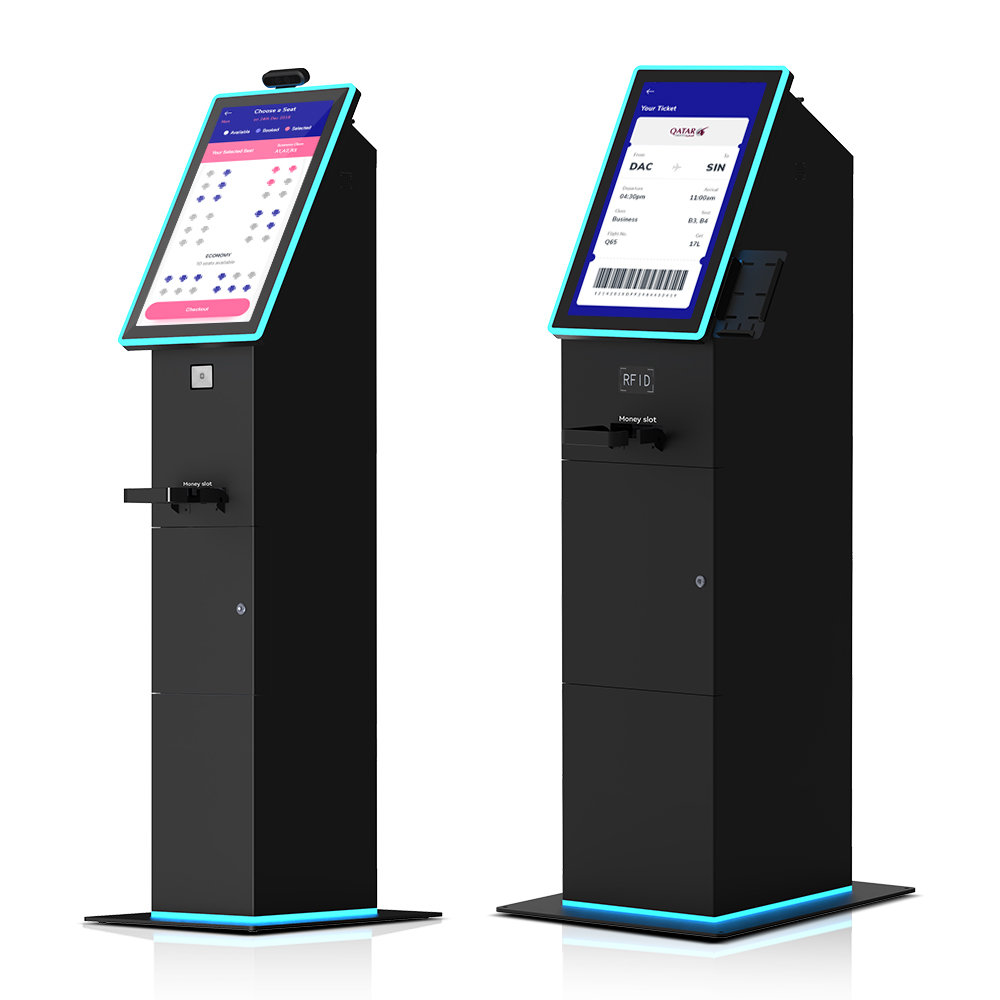
The US-K320FS-2 hotel check-in kiosk cabinet is a floor-standing OEM/ODM platform for hotel and hospitality projects: enclosure, peripheral modules and branding are confirmed by project configuration, with a published product specification sheet rather than a verbal description.
Next step
If you are evaluating suppliers for a 2026 rollout, start with evidence, not price:
- Request a quote and configuration worksheet for your lobby — tell us your PMS, payment method and ID-verification requirement and we will map the module set.
- Request a sample unit for a physical integration and accessibility test.
- Request the datasheet for the cabinet above if you only need specs today.
Projects that start from the datasheet and end at the sample unit move faster than projects that start with a price and end with a redesign.
FAQ
How long does a hotel check-in kiosk rollout take? Hardware lead time is usually the shorter leg. A standard cabinet runs a few weeks in production; the long pole is PMS integration testing and any certification work required by your market.
Do I need PCI DSS certification myself if I deploy kiosks? It depends on where card data enters and terminates. P2PE and tokenized architectures can push most of the scope to the payment provider — but you must know which architecture you bought.
Is accessibility optional in the US and EU? No. The EU’s European Accessibility Act covers self-service terminals and is enforced as a market-access condition; in the US, ADA plus the 2026 federal digital deadlines drive both legal and funding pressure.
Can I buy the cabinet from an OEM and the software elsewhere? Yes — this is the most common structure. It does mean you should vet the integration contract between the two vendors before signing either.