Quick answer: Olea’s Franklin bundles bill accept, bill dispense, optional coin and check into one US-made cabinet. This buyer’s comparison sets its published spec against configurable OEM platforms (US-K215CB, US-K236CB-2) on module choice, screen size, environment range, MOQ and lead time — so you can tell whic
Overview
Direct answer: For a bill-payment or cash-in/cash-out project you are choosing between two sourcing models, not two boxes. Olea’s Franklin is a single, pre-integrated cabinet that bundles bill accept, bill dispense, optional coin and check handling, built in the USA. A configurable OEM platform such as Usingwin’s US-K215CB or US-K236CB-2 lets you select the cash module, screen size and computer, publish the full CPU/OS spec, and start at MOQ 1 with a 20–25 day lead time. If your priority is a proven turnkey US deployment, Franklin leads. If your priority is module flexibility, transparent specs, cost and speed, the OEM route leads.
Why this decision is on the table in 2026
Cash-handling hardware stopped being a niche accessory. With cash-acceptance mandates spreading across US and EU markets, cash modules are now a compliance spec rather than a convenience option. Buyers who used to ask “card or cash?” now ask a harder question: which cash module, from which supplier, with what published parameters and what certification path. If you have not yet mapped that requirement, our breakdown of cash acceptance mandates as a compliance spec is the right starting point.
That shifts the comparison away from “which kiosk looks better” toward “which sourcing model de-risks my deployment.” This article does that comparison with only published, verifiable specs.
What “cash-handling” really covers in a spec sheet
Before comparing two products, separate five functions that are often bundled under one label. Each is defined below so you can match it against your own workflow requirements:
- Bill acceptance (validator). A bill validator accepts banknotes, checks authenticity with infrared and UV sensors, and counts the deposited value; the US-K236CB-2, for example, lists a JCM acceptor with infrared/UV authentication and denomination recognition.
- Bill recycling. A recycler accepts notes and then re-issues the same notes as change, which cuts the starting cash float a site must load before opening; the US-K215CB lists mixed-denomination recycling and payout in the ITL Spectral Payout / NV4000 Spectral class.
- Bill dispensing. A dispenser pays notes out from a dedicated payout module that is separate from the acceptance path, so dispensing does not depend on what a customer just inserted.
- Coin dispensing. Change is paid in coins from a hopper, usually one hopper per denomination — Olea’s Franklin lists an optional 3-hopper coin dispenser, and the US-K236CB-2 lists coin storage modules plus a coin hopper.
- Check reading. MICR capture reads the routing and account numbers printed on a paper check, a requirement for bill-pay and remittance workflows; Franklin lists a check reader as an optional module.
A product that does three of these is not interchangeable with one that does five. Decide which functions your workflow genuinely requires, then read the spec sheet against that list. Our comparison of cash, card and biometric payment hardware covers the adjacent question of what to specify across payment types.
Olea Franklin: what the published spec actually promises
Olea publishes the Franklin’s specification directly on its product page and datasheet. As listed, the standard build includes:
- 19″ touchscreen
- High-capacity, modular bill acceptor
- High-capacity, modular bill dispenser
- Ingenico / VeriFone credit-card payment devices
- Barcode scanner; modular computer (Windows, Android or Linux)
- Security locks; internal 6-outlet power strip with surge protection; topple-resistant base plate that can be bolted to the ground
Dimensions are published as 22″ wide (body), 53.5″ high, 22″ deep, with a 23″ × 24″ base plate. Optional components include an internal safe, a check reader, an ADA-compliant storm headphone jack, a 1080p HD webcam, an additional security door for the bill acceptor, a 3-hopper coin dispenser, a 2D imager and an 80mm thermal receipt printer. Olea states the unit is manufactured in the USA (Cerritos, California).
What the page does not publish: processor model, RAM/storage, IP rating, operating temperature range, or price. Its cash module is described functionally (“high-capacity, modular”), not by maker and model number.
Usingwin US-K215CB and US-K236CB-2: the published configuration
Both are freestanding, build-to-order platforms. The parameters below are transcribed from the official specification sheets linked on each product page.
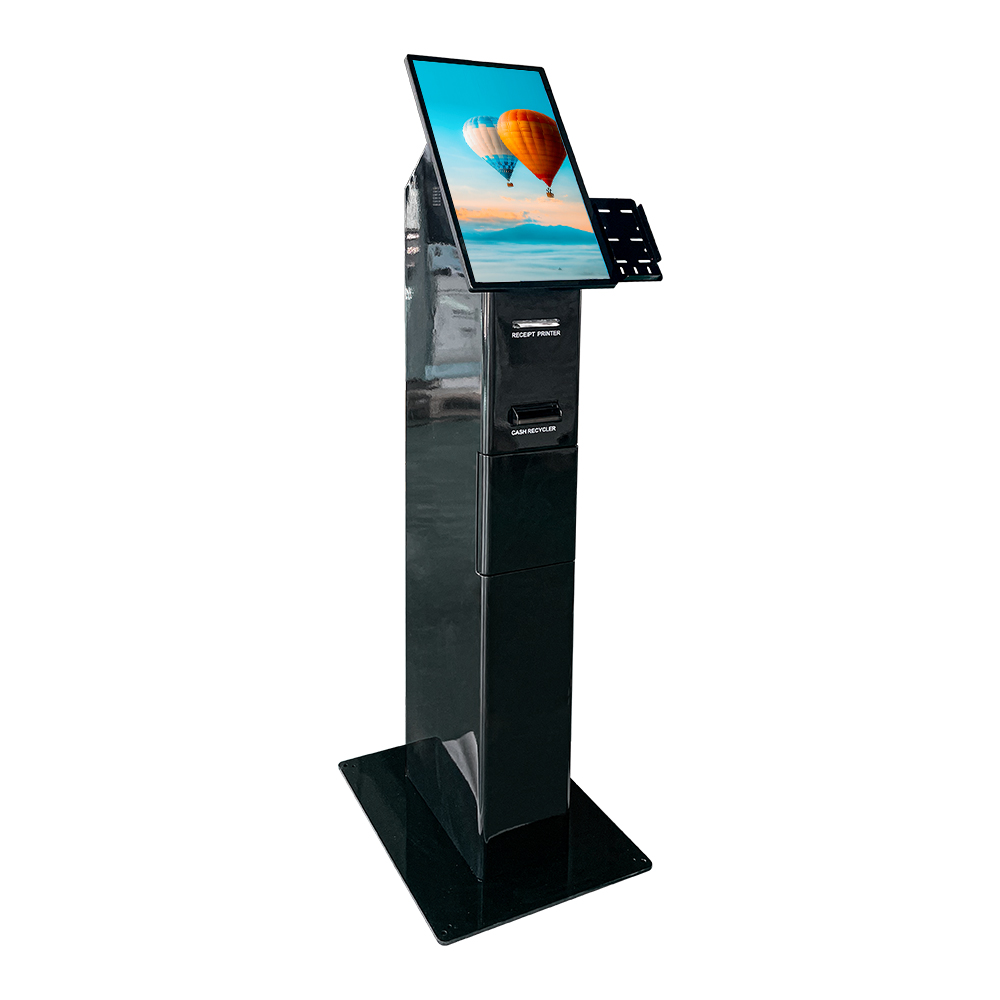
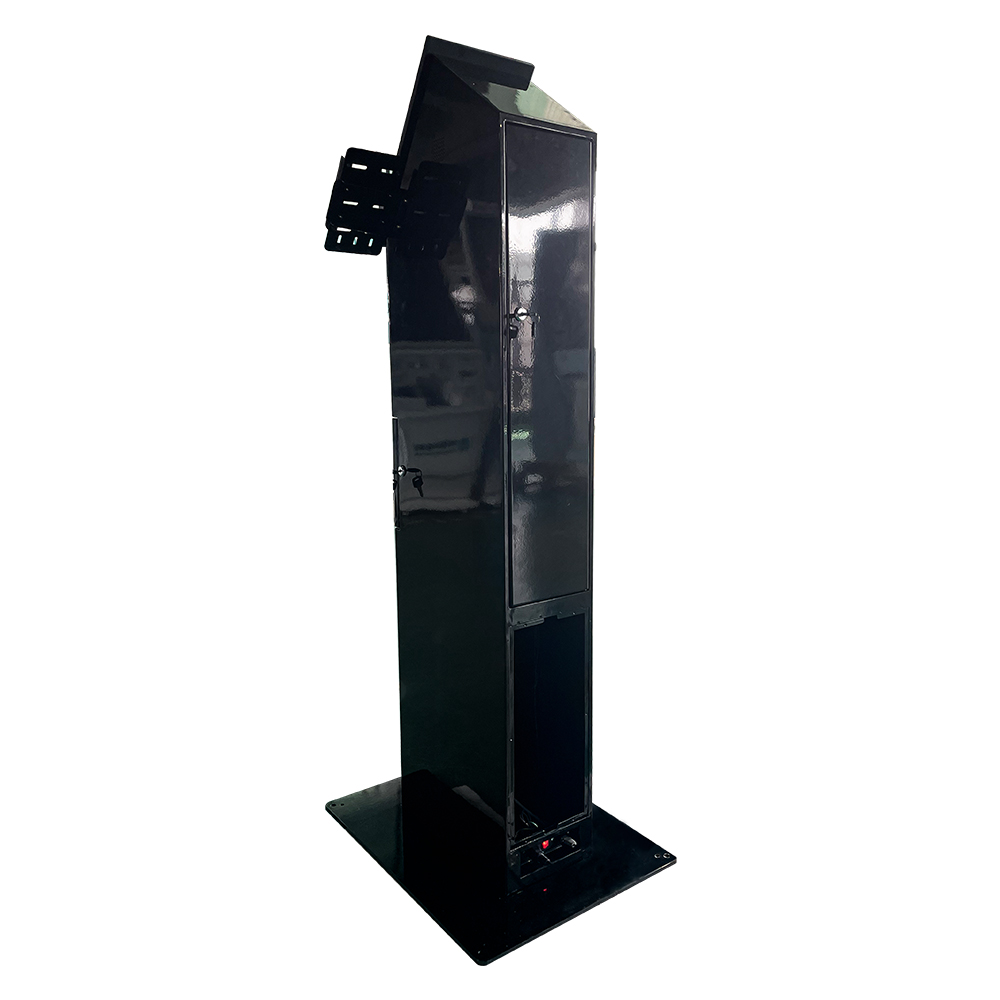
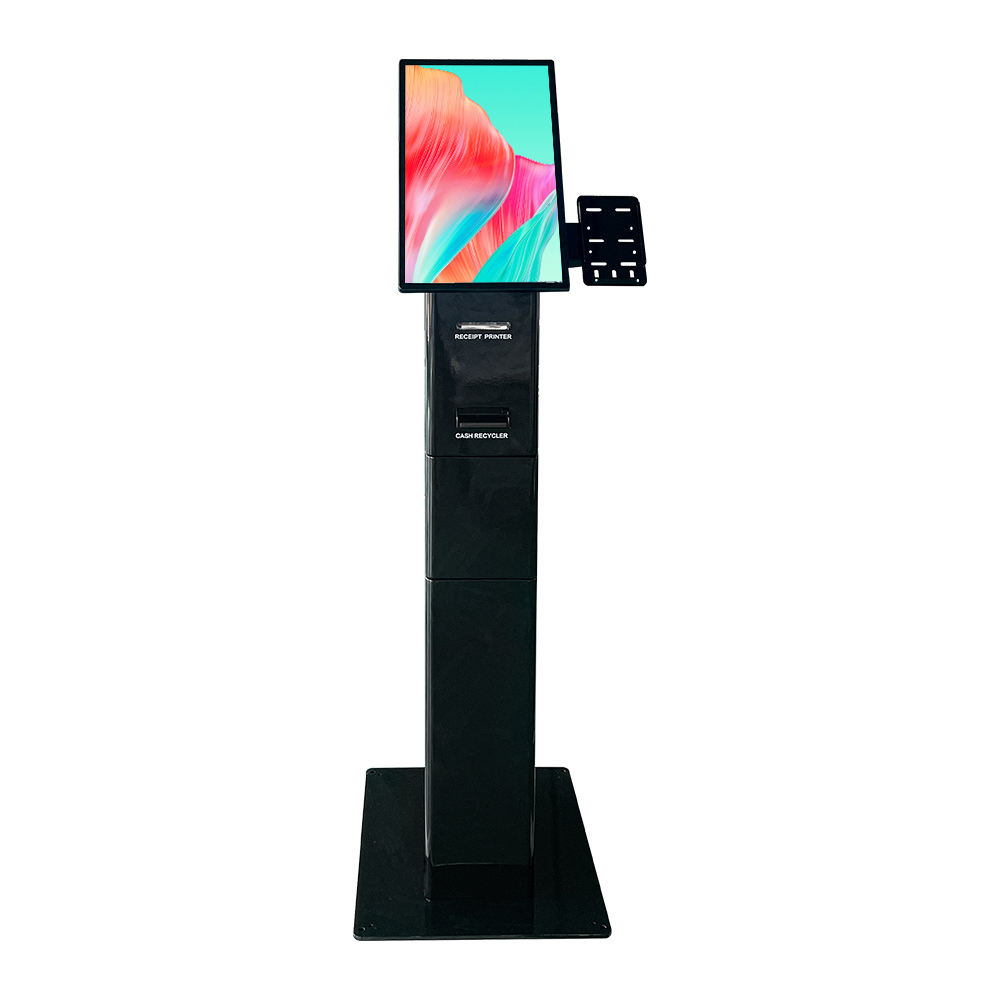
US-K215CB — a cash-handling platform for gaming/redemption and hotel/travel workflows. Cabinet 540 × 350 × 1513.9 mm, net 48 kg. Display options 15.6″ or 21.5″ capacitive, 1920×1080, 10-point touch. Computing: Intel i3/i5/i7/J6412 or RK3568/3576/3588; Android 11/13/14/16, Windows 10/11, or Linux (Debian, Ubuntu); Windows memory 4–64GB, Android 2–8GB. Operating temperature 0–40°C. Cash module described as a bill acceptor and recycler (example: ITL Spectral Payout / NV4000 Spectral) — acceptance, validation and mixed-denomination recycling/payout. Peripherals include a 58/80mm thermal printer, QR/barcode scanner, dual-frequency NFC/RFID reader, adjustable POS mounting bracket for a customer-owned card terminal, and mono or dual-lens camera. MOQ 1 unit; lead time 20 business days.
US-K236CB-2 — positioned as a currency-exchange kiosk for airport/hotel and government/finance use. Cabinet 490 × 403 × 1505 mm. Display 23.6″ flat or curved capacitive, 1920×1080, 10-point touch. Same CPU/OS/memory range as above, operating temperature 0–50°C, 7×24 continuous operation. Cash handling lists a JCM bill acceptor (infrared/UV authenticity checks, denomination recognition, automated counting and settlement statistics) plus coin storage modules and a coin hopper. The model also lists 15-language support and acceptance of 10–20 currencies. MOQ 1 unit; lead time 20–25 business days. Integrity note: the source sheet’s “Fujitsu Bill Dispenser” row is actually described as a coin hopper holding three yen denominations, and the document itself flags a label/description conflict requiring confirmation — so treat the dispenser description as unconfirmed until the final bill of materials is issued.
Side-by-side on published data only
| Parameter | Olea Franklin | Usingwin US-K215CB | Usingwin US-K236CB-2 |
|---|---|---|---|
| Screen | 19″ touchscreen | 15.6″ / 21.5″ (option) | 23.6″ flat or curved (option) |
| Bill accept | Modular high-capacity acceptor | Acceptor + recycler (ITL-class example) | JCM acceptor, IR/UV validation |
| Bill dispense / recycle | High-capacity modular dispenser | Mixed-denomination recycle & payout | Counting + change logic (see integrity note) |
| Coin | Optional 3-hopper dispenser | Not listed as standard | Coin hopper + storage modules |
| Check reader | Optional | Not listed | Not listed |
| Internal safe | Optional | Not listed | Not listed |
| Card payments | Ingenico / VeriFone integrated | Adjustable bracket for customer-owned terminal; NFC/RFID reader | Adjustable bracket for customer-owned terminal |
| CPU / OS published | Not published (stated as modular) | Yes — Intel / Rockchip; Android, Windows, Linux | Yes — same range |
| Operating temp. | Not published | 0–40°C | 0–50°C |
| Cabinet footprint | 22″ W × 22″ D; 53.5″ H | 540 × 350 mm; 1513.9 mm H | 490 × 403 mm; 1505 mm H |
| MOQ | Not published | 1 unit | 1 unit |
| Lead time | Not published | 20 business days | 20–25 business days |
| Origin | Manufactured in USA (CA) | OEM/ODM, configured to order | OEM/ODM, configured to order |
| Price | Quote only | Quote only | Quote only |
“Not published” means the value does not appear on the public specification we reviewed — it is not a claim that the capability is absent. Confirm directly before treating any gap as a difference.
Where each option wins — read this honestly
Olea Franklin wins on integration and brand assurance. It is a single cabinet that already bundles bill accept, bill dispense, optional coin, optional check and an optional safe — the full bill-pay function set in one pre-engineered unit, with a US manufacturing and support story that reassures North American enterprise buyers and simplifies vendor risk. For a compliance-sensitive US deployment with a short decision cycle, that is real value.
Usingwin wins on module flexibility, published specs and commercial terms. The cash module, processor, OS, screen size and peripherals are stated and selectable; the full computing spec is on the page where Franklin’s is not. A 23.6″ display and a 0–50°C operating ceiling cover environments a 19″ indoor unit may not. MOQ 1 with a 20–25 day lead time lets you run a pilot without a large commitment. For cost-sensitive or custom-branded projects — and for markets where the “made in USA” premium is hard to justify — that combination is the stronger fit.
The honest gap: if your workflow needs check reading, coin dispensing and an internal safe together, Franklin bundles all three today, while our two reviewed models list neither a check reader nor an internal safe (US-K236CB-2 does list coin modules). That is a genuine functional gap for full bill-pay remittance, and it is better resolved at configuration time than discovered at installation.
Three questions to ask any supplier before you sign
- “Which exact cash module, by maker and model?” “High-capacity modular” is not a spec. Ask for the acceptor, dispenser and recycler part numbers, plus the currencies and denominations each supports at your note mix.
- “Show me the computing and environment parameters in writing.” Processor, RAM, OS version and operating temperature determine whether the unit survives your real site. If they are unpublished, get them in the quotation.
- “What is the certification and configuration-change path?” For PCI DSS and payment work, confirm card-data scope and P2PE expectations before launch; for OEM/ODM supply, confirm CE, FCC and RoHS coverage. Our PCI DSS / P2PE audit guide and 2026 OEM/ODM procurement checklist list the documents to request. If your model choice is still open, OEM vs ODM vs white-label compared covers the cost and lead-time trade-offs.
Next step
Tell us your workflow (bill-pay, FX, redemption or ticketing), your note and coin mix, your site’s temperature range and your target MOQ. We will return a configuration with the actual cash-module model, the full computing spec and a firm lead time — so you can bid us against Franklin on identical parameters rather than on marketing copy.
Review the US-K215CB specification , review the US-K236CB-2 specification , or request a configuration and quotation citing “bill-pay” so it routes to the right engineer.
Is Olea’s Franklin a good kiosk?
Yes — it is a well-integrated, US-made bill-pay platform with a broad optional-module set. The sourcing question is whether a fixed, pre-integrated platform or a configurable OEM platform matches your project’s cost, customization and speed priorities.
Which is cheaper?
Neither publishes pricing, so no comparison is possible from public data. Any claim of a price gap without a quotation is unverified. Request quotes on the same configuration to compare.
Can Usingwin match Franklin’s check reader and internal safe?
Those two functions are not listed on the US-K215CB or US-K236CB-2 specification sheets we reviewed. Raise them explicitly as configuration requirements so engineering confirms feasibility before you commit.
Why does the spec transparency difference matter?
Because the buyer carries the integration risk. A published CPU, OS and temperature range can be validated against your software and site conditions before purchase; an unpublished one cannot.