Quick answer: The short answer: a hotel check-in kiosk is only genuinely cash-capable when the quote specifies five layers — cash-in validation, cash storage or recycling, change dispensing, a safe-drop or cash-in-transit (CIT) interface, and a reconciliation report that posts back to the PMS folio — and when a named party owns daily reconciliation. A quote that lists a note acceptor but no dispenser, no safe-drop sequence and no shift-close report is not a cash quote; it is a card quote with a note reader bolted on.
The short answer: a hotel check-in kiosk is only genuinely cash-capable when the quote specifies five layers — cash-in validation, cash storage or recycling, change dispensing, a safe-drop or cash-in-transit (CIT) interface, and a reconciliation report that posts back to the PMS folio — and when a named party owns daily reconciliation. A quote that lists a note acceptor but no dispenser, no safe-drop sequence and no shift-close report is not a cash quote; it is a card quote with a note reader bolted on.
Most hotel kiosk pages you will shortlist describe the same four-step flow: find the reservation, verify ID, take payment by card or mobile wallet, issue a key. That flow is accurate and almost useless for a cash decision, because it never touches the parts that change your bill of materials, your compliance scope, your front-desk staffing or your insurance. This checklist is built to test quotes on those parts.
Why the Cash Path — Not the Touchscreen — Decides the Shortlist
Cash handling adds cost centres that card-only configurations never carry: cassette capacity, jam recovery and the labour to clear it, counterfeit rejection and the escalation it triggers, change inventory, safe access control, CIT pickup frequency, cash-in-transit insurance, and a reconciliation routine that must reconcile three records at once — notes counted in the kiosk, notes removed at shift close, and folios posted in the PMS.
State this plainly to every vendor you shortlist: cash handling adds CIT, safe, jam-recovery and reconciliation costs, and no vendor-supplied ROI figure will be accepted without operator-confirmed performance data from a comparable property. That single sentence filters out most brochure-grade proposals.
1. Map the Cash Journey Before You Compare Hardware
A pre-quote site survey is the cheapest risk control in this project. Treat it as a recommended audit, not a measured benchmark — walk the property and record, per location:
- What the cash actually is. Balance settlement at arrival, a cash deposit in place of a card pre-authorisation, an incidental hold, a cash top-up mid-stay, or a refund at check-out. Each one changes the module mix and the PMS posting logic.
- The real mix. Currencies, note denominations, whether coins are used at all, typical transaction value, and the peak arrival window where cash volume concentrates.
- Cash-in versus cash-out. Accepting notes is not the same as returning change. Ask explicitly whether the configuration dispenses change, and from which denominations.
- Escalation and shift close. Who is called when a note is rejected or a cassette fills, how the drawer is closed at shift end, and when CIT collects.
Then ask each vendor to draw the end-to-end cash journey from the guest touchscreen to the shift-close report to CIT pickup. Compare drawings, not brochures — the gaps in a drawing are the gaps in the quote.
2. Split PCI DSS, Identity-Data and Cash-Security Ownership in Writing
Cash and card are two different compliance problems and they are routinely blurred in kiosk proposals. Cash acceptance sits outside PCI DSS scope, but the card path does not: the payment terminal, any kiosk software that touches cardholder data, the network segment it sits on and the PMS posting path all fall inside the cardholder data environment you must define. Use the PCI Security Standards Council's scoping and segmentation guidance as the reference document, and require the vendor to state which components they claim are out of scope and why.
For the card interface, ask whether the reader is certified to the EMVCo contact-interface specifications for chip transactions, and remember that EMVCo specifications describe the interface — they do not certify your finished kiosk. Certification of the assembled unit is a separate question (see step 7).
For scanned passports and IDs, the retention question is a data-protection one: in the EU, the GDPR storage-limitation principle applies; in the US, applicable state privacy law applies. Require a written answer on who can export, retain and delete guest identity data, and for how long.
Deliverable: a one-page responsibility matrix covering payment terminal certification, tokenisation, ID-document retention, CCTV coverage, safe access, audit-log custody — and a named owner for each row across vendor, integrator, PMS supplier, acquirer and hotel.
3. Match the Acceptor and Recycler to Your Actual Note and Coin Mix
Specify, in the RFQ rather than the clarifications call:
- Supported currencies and note/coin denominations, and whether each module validates, stacks or recycles.
- Cassette capacity per denomination, and the resulting replenishment and collection interval at your peak volume.
- Counterfeit-validation method, and the exception path for a disputed note — it must route to front-desk staff without silently holding the reservation.
- Jam-recovery procedure, plus a mean-time-to-recover figure drawn from operator-confirmed deployments. Reject generic uptime percentages.
- Audit-log contents: timestamp, denomination, transaction ID, cassette events, safe-drop events.
For casino or resort properties, add the requirement that the same audit trail satisfies both hotel finance and the gaming-compliance team, and that cassette removal is a controlled, logged procedure.
4. Prove the PMS, Identity and Key Workflow — Including the Fallback
Test reservation lookup, ID verification, payment authorisation, folio posting, room assignment and key encoding as one flow in a single demonstration. Disconnected demos hide the integration risk, and integration is where most kiosk complaints actually originate — the hardware is usually fine, the synchronisation is not.
Ask for a demonstrated reservation-to-folio test against your named PMS. "PMS-agnostic" is not evidence; ask for the documented API, the list of PMS versions tested, and the exception path for a dropped connection mid-transaction. Define in writing what happens when an ID scan fails, a card is declined, a guest pays part of the balance in cash, or a guest simply needs a human.
5. Reconcile Cash to the PMS and General Ledger Daily
This is the step that separates an operable kiosk from a demo unit. Require a shift-close report that reconciles, in one auditable view: cash accepted, change dispensed, safe-drop deposits, card settlements and PMS folios — by terminal, by operator, by shift.
Specify variance handling: who investigates over/short amounts, how adjustments are posted, how long the kiosk audit log is retained, and how duplicate charges are prevented when a guest retries a payment or the PMS connection drops. If the answer is "the PMS handles it", ask the PMS supplier to confirm that in writing.
Build any ROI case from your own survey data — cash-path labour hours, CIT frequency, front-desk rework — and label the model illustrative until the property supplies its own volumes and staffing figures.
6. Vet Placement, Accessibility and Physical Security
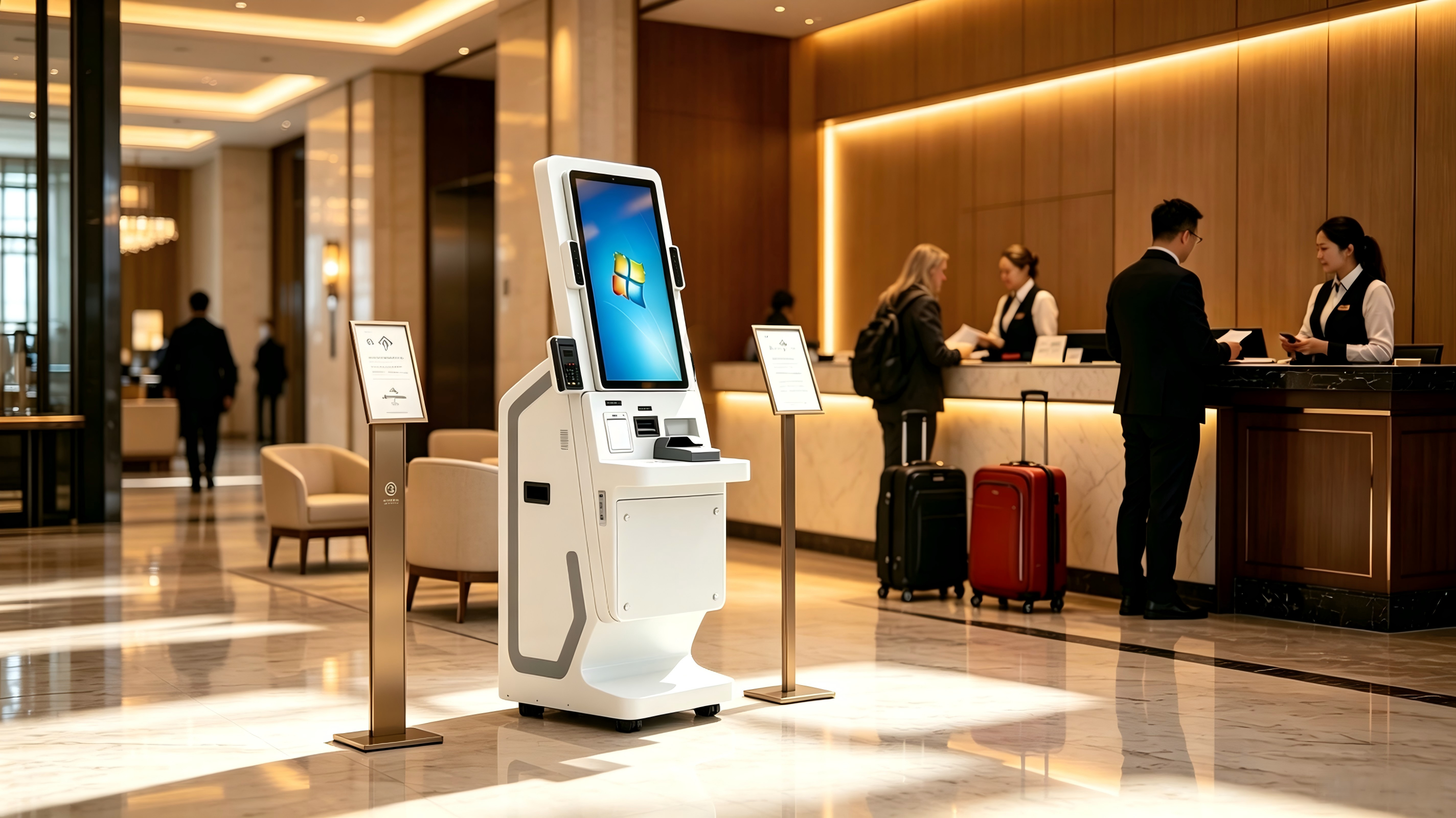
Check lobby placement for privacy at the screen, queue flow, lighting, network coverage, and safe-drop access that does not expose cassettes to waiting guests. Verify the installation against the ADA 2010 Standards for reach ranges (§308) and operable parts (§309) — the acceptor, dispenser, card reader and receipt printer must all sit within the operable range for the installed height, and a kiosk that meets the standard for the touchscreen can still fail at the change dispenser.
Confirm anchoring, CCTV coverage, tamper alarms and cassette-removal protocol with the hotel's security contractor. For outdoor or 24-hour units, state the ingress-protection rating and operating-temperature range as a requirement rather than assuming lobby hardware will survive a covered exterior location.
7. Pressure-Test the OEM/ODM Quote: MOQ, Lead Time, Certification, Service
- Who owns certification for the finished kiosk versus the payment and cash modules? Request certificate scope, not a logo.
- MOQ, tooling or customisation charges, sample lead time, production lead time, and the change-order process between pilot and chain rollout.
- Warranty terms by module — touchscreen, cash acceptor, recycler, dispenser, printer, key encoder — plus spare-parts availability and on-site response SLA.
- For integrators: a clear boundary between hardware supply, software licensing, PMS integration work and post-launch support.
Quote Comparison Table: Put These Columns Side by Side
| Criterion | What to record | Status options |
|---|---|---|
| Cash-in validation | Currencies, denominations, counterfeit method, rejection path | Included / Optional / Third-party / Not offered |
| Cash-out | Change dispenser present, denominations, capacity | Included / Optional / Not offered |
| Recycling | Notes recycled vs stacked only | Included / Optional / Not offered |
| Safe-drop / CIT interface | Cassette removal procedure, logging, access control | Included / Optional / Not offered |
| Audit and shift-close report | Fields reconciled, retention period | Included / Optional / Not offered |
| PMS integration | Named PMS and version, demonstrated folio posting | Demonstrated / Claimed only |
| PCI DSS responsibility | Scope boundary per component, named owner | Documented / Undefined |
| ADA verification | Reach range for every operable part | Verified / To verify |
| MOQ and lead time | Sample and production lead times, change-order terms | Stated / Not stated |
| Service SLA | Response time, spare parts, jam-clear support | Stated / Not stated |
| Jam rate, uptime, ROI claims | Source of figure and deployment conditions | Operator-confirmed / Requires confirmation |
Use the completed table as the agenda for the clarification call — not as a substitute for a live workflow demonstration.
Red Flags That Should Stop a Shortlist
- A quote with a card terminal but no acceptor, recycler, dispenser or safe-drop path.
- A vendor who cannot say who owns PCI DSS scope, PMS write-back, cash reconciliation or identity-data retention.
- "PMS-agnostic" with no named integration test, documented API or exception-handling description.
- An ROI or uptime claim without deployment conditions, or a warranty that does not state exclusions.
Common Buyer Questions, Answered Briefly
Can a hotel check-in kiosk take both cash and card? Yes, but treat them as two separately specified paths. The card path needs a certified terminal and a defined scope boundary; the cash path needs acceptor, storage, change, safe-drop and reconciliation. A configuration that quotes only one path is incomplete.
Who owns PCI DSS compliance when cash is handled separately? Cash does not remove card scope. The hotel group remains accountable for defining the cardholder data environment; the vendor and integrator own the components they supply. Put that split in the responsibility matrix before signing.
How is kiosk cash reconciled to PMS folios? Through a shift-close report that ties notes accepted, change dispensed, safe-drop deposits and card settlements to folios by terminal and shift, with a documented variance procedure and retained audit log.
What MOQ and lead time should be expected? It depends on module mix and customisation, and no credible number exists without a specification. Ask for sample and production lead times in writing against your configuration, and compare them across at least three vendors on identical scope.
Next Step: Request a Cash-Capable Configuration and Quote
Shortlist only vendors who quote the complete cash path, draw the end-to-end journey, and assign reconciliation, compliance and service ownership in writing. Everything else is a card kiosk with a note reader.
To move from checklist to configuration, send us: property type and location, currencies and note mix, peak arrival volume, named PMS and payment provider, required cash modules (acceptor only, acceptor plus recycler, change dispenser, safe-drop), accessibility constraints at the intended location, and pilot versus rollout quantities. We will return a cash-capable hotel kiosk configuration and quote, with module-level scope, certificate documentation and integration boundaries stated explicitly — plus a datasheet or sample discussion if you want to test the hardware before committing to a pilot.
Request a cash-capable hotel kiosk configuration and quote. Include your survey notes from step 1 and we will map them to an acceptor/recycler/dispenser specification instead of a generic brochure configuration.