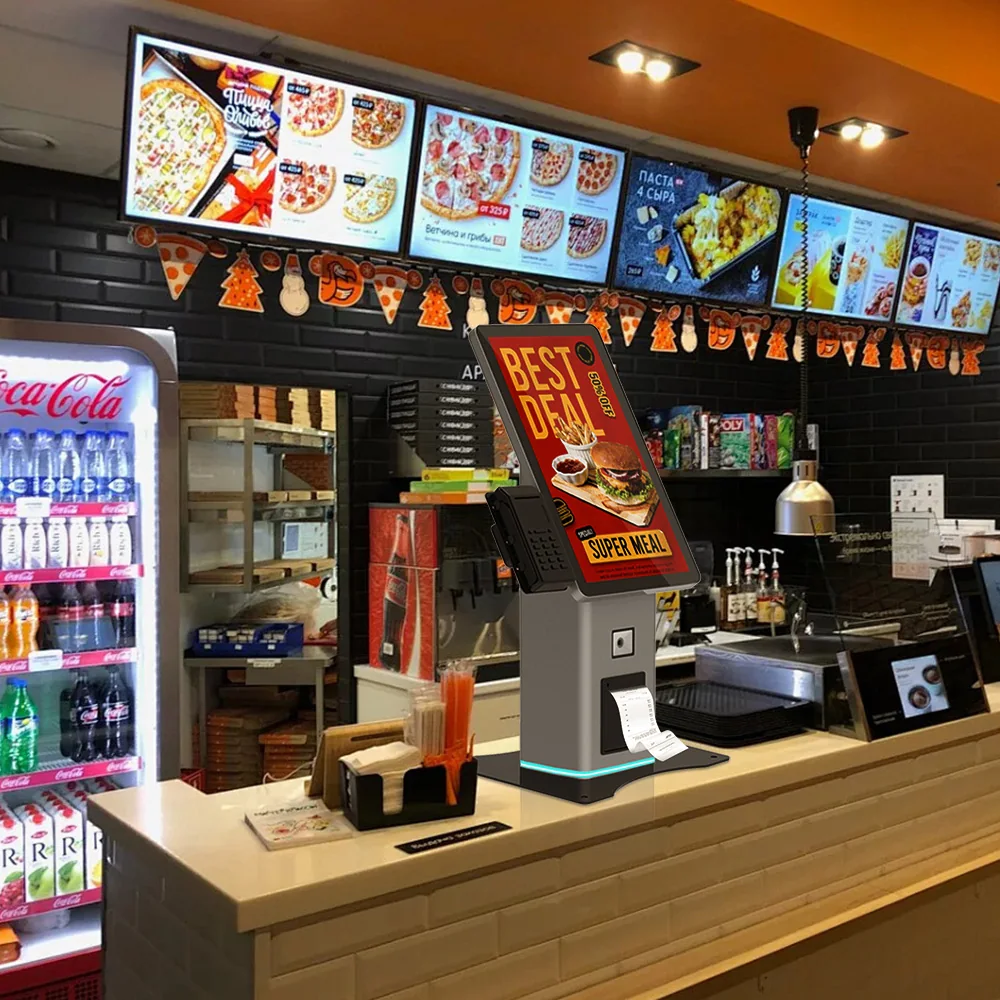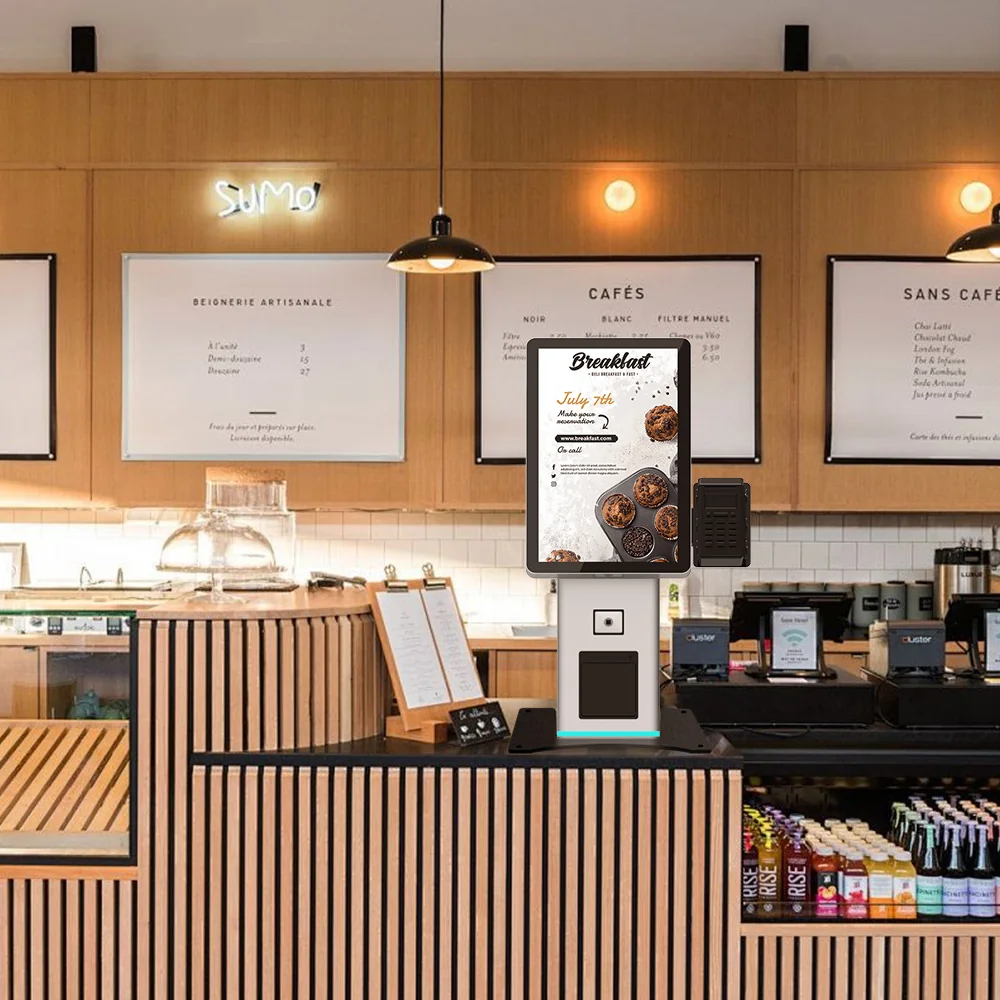

Quick answer: A hotel self-check-in kiosk is three integrations delivered on one cabinet — reservation lookup into the property-management system (PMS), room-key encoding against the door-lock system, and payment pre-authorisation into the acquirer. An arrival only completes unattended when all three are verified. Usingwin supplies the US-K320FS-2 hotel check-in kiosk cabinet as an OEM/ODM-ready format with a 20–25 business-day lead time; the PMS and lock interfaces, not the enclosure, usually decide your go-live date — so scope them before the cabinet is frozen.
Overview
Quick answer: A hotel self-check-in kiosk is three integrations delivered on one cabinet — reservation lookup into the property-management system (PMS), room-key encoding against the door-lock system, and payment pre-authorisation into the acquirer. An arrival only completes unattended when all three are verified. Usingwin supplies the US-K320FS-2 hotel check-in kiosk cabinet as an OEM/ODM-ready format with a 20–25 business-day lead time; the PMS and lock interfaces, not the enclosure, usually decide your go-live date — so scope them before the cabinet is frozen.
Why the labor-ROI case moved in 2026
Two numbers moved hotel self-service from “premium amenity” to “staffing answer”: the hotel self check-in kiosk market roughly doubles by 2032, and hospitality wages are up about 20% since 2019. Both are sourced below.
- A doubling market. The hotel self check-in & check-out kiosk market is estimated at USD 2.57 billion in 2026 , forecast to reach USD 4.98 billion by 2032 — a CAGR of about 11.3% ( ResearchAndMarkets / GlobeNewswire , Jan 2026). Broader self-service kiosk demand grows on the same curve (Mordor Intelligence: USD 14.52bn in 2025 → USD 16.24bn in 2026 → USD 28.41bn by 2031, 11.84% CAGR).
- Wages that will not reset. Hospitality wages are up roughly 20% since 2019 ( AHLA data reported by Hotel Dive ), while labor typically consumes 20–30% of hotel revenue . Front desk is one of the few cost lines a hotel can partially shift to self-service without cutting guest-facing service.
The buying conversation has therefore shifted from appearance to two measurable questions: which share of arrivals the kiosk can finish fully unattended , and how many months until that saved front-desk time repays the capex . Both answers depend on the same two variables — the unattended completion rate and your fully-loaded front-desk hourly cost — and a defensible proposal should state both, rather than a lobby-photo benefit.
The three integrations that decide go-live
Go-live is decided by three interface handoffs, not by the cabinet. Scope each one separately, with a named owner on the hotel side and a written interface confirmation, before production is approved:
- PMS reservation lookup — decides whether an arrival can be found and completed unattended at all; without a test booking retrieved end-to-end against the hotel’s actual PMS version, no other integration matters.
- Room-key encoding — decides whether the guest can actually enter the room; it is proven only when a kiosk-issued card opens the property’s real door, not a bench test.
- Payment authorisation — decides whether incidental pre-auth and folio settlement close without a staff member; it is proven by a full authorise → post-to-folio → void/refund cycle against the acquirer.
| Integration | What the kiosk must do | Typical interface | Buyer’s evidence to request |
|---|---|---|---|
| 1. PMS reservation lookup | Find the booking by surname / confirmation / loyalty ID; read room type, rate, and arrival status; write the checked-in flag back. | PMS vendor API/SDK (e.g. Oracle OPERA Kiosk SOAP interface, or ORS / Hospitality Integration Platform for OPERA Cloud); some properties expose only a middleware. | A test booking retrieved end-to-end, plus proof an unmatched reservation is handled without exposing other guests’ records. |
| 2. Room-key encoding | Encode a key against the assigned room, with correct validity window and door-system compatibility. | Lock-vendor encoder (serial / Ethernet) + card-dispenser SDK supplied by the hardware vendor. | A card issued by the kiosk opened at the target door, tested on the property’s actual lock system — not a bench test. |
| 3. Payment authorisation | Pre-authorise incidentals and settle at checkout against the PMS folio. | Acquirer / PSP terminal integration; PCI DSS scope must be defined (see PCI DSS / P2PE for payment kiosks ). | A successful authorise → post-to-folio → void/refund cycle, plus written confirmation of where card data is encrypted. |
Non-negotiable — PMS and door-lock compatibility is never universal, and it is decided by four named items, not by the kiosk cabinet: the exact PMS version and its interface path (e.g. Oracle OPERA Kiosk SOAP, or ORS / Hospitality Integration Platform for OPERA Cloud, or a property middleware); the lock vendor’s encoder and card standard (LF/HF RFID ISO 15693 or MIFARE, or magstripe); the acquirer / PSP authorisation route; and written confirmation of which vendor owns each interface when it changes. Request all four in writing before production is approved. (This is covered in more depth in Hotel Self Check-In Kiosk Requirements ; treat that page as the workflow checklist and this one as the integration + ROI layer.)
Specifying the key-card module — five decisions
The room-key module is the most common source of post-deployment rework, because card format and encoder choice are usually locked to the property’s existing locks:
| Decision | Options to confirm | Why it matters |
|---|---|---|
| Card technology | LF/HF RFID (ISO 15693 / MIFARE), magstripe, or dual | Must match the installed lock base, not the newest standard. |
| Encoder placement | Integrated encoder inside the kiosk vs external encoder | Integrated saves space but binds the kiosk to one lock brand. |
| Dispensing mechanism | Card hopper capacity, replenishment access, jam recovery | Drives maintenance visits and front-desk intervention rate. |
| Validity logic | Check-in time to checkout, multi-night, late checkout | Encoded on the card; logic errors send guests back to reception. |
| Failure fallback | What happens if a card fails to issue | Must route to reception with enough info to finish without re-charging. |
Labor ROI: how to build the number honestly
Published benchmarks are directional, not promises. Two useful anchors: hotels adopting self check-in typically see measurable ROI within 6–12 months ( Akia ), while a more conservative view holds that payback can take up to a couple of years depending on volume ( HotelTechReport ). The gap is almost entirely driven by how many check-ins the kiosk actually completes unattended.
Build the ROI case from four inputs you own — annual arrivals, unattended completion rate, minutes saved per check-in, and your fully-loaded hourly cost — not from a vendor’s projected saving. The table below shows an illustrative calculation.
| Input | Where it comes from | Illustrative example* |
|---|---|---|
| Annual arrivals | PMS occupancy report | 60,000 room-nights, ~1.4 guests/booking → 42,000 arrivals |
| Kiosk completion rate | Pilot / vendor reference, capped conservatively | 50% of arrivals finish fully unattended → 21,000 |
| Minutes saved per check-in | Time-and-motion at your desk | 3 minutes of staff time avoided → 1,050 staff-hours/year |
| Fully-loaded hourly cost | Payroll + on-costs | USD 22/hour → ~USD 23,100/year avoided task time |
*Illustrative arithmetic only — substitute your own property’s figures. The point is that a defensible business case uses front-desk minutes actually removed, not headcount removed: most hotels redeploy staff to service and upsell rather than cutting the role.
Then subtract the real cost of ownership: kiosk capex, integration/SDK effort, payment certification scope, consumables, and maintenance visits. A hybrid model — kiosk plus remote-assistance fallback — is the pattern most operators land on; one published hybrid deployment reported 60% of check-ins handled by virtual reception, an 80% remote-resolution rate, and 375 guest-hours saved per month (Virdee case study). Treat those as a reference point for what a mature hybrid model can reach, not a baseline you can assume from day one.
Risk and de-risk
| Risk | De-risk move before production |
|---|---|
| PMS API access is restricted or charged | Confirm interface access in writing during technical review; budget the middleware if the property exposes none. |
| Lock-system mismatch discovered late | Test the issued card on the property’s real doors during the prototype stage, not at acceptance. |
| Guests queue because check-in fails mid-journey | Define the exception path (early arrival, no room, failed payment, card error) and route it to reception with case data intact. |
| Privacy / accessibility exposure | Define what guest data may render on-screen, enforce session wipe on timeout, and specify accessible reach ranges and alternative assistance. Review deployment-specific privacy and identity requirements with the property’s advisers. |
| Vendor change breaks integration | Contract clarity on who maintains the interface when the PMS or lock vendor ships an update. |
Hardware, scoped after the interfaces
Once the three integrations and the exception path are fixed, the cabinet becomes a configuration exercise. Usingwin supplies the US-K320FS-2 hotel check-in kiosk cabinet as a freestanding, OEM/ODM-ready format with peripheral and branding options confirmed per project configuration — lead time 20–25 business days , MOQ confirmed by configuration. Identity, room-card, payment and print modules are selected to match the approved guest journey and the interfaces the property’s PMS and lock vendors make available.
The US-K320FS-2 is a freestanding hotel self-check-in kiosk cabinet supplied by Usingwin as an OEM/ODM-ready format for hotel and hospitality deployments — 20–25 business-day lead time, MOQ confirmed by configuration, with identity, room-card, payment and print modules selected against the approved guest journey.
→ Review the format and datasheet: US-K320FS-2 hotel check-in kiosk · product specification (xlsx) → Scope integration and prototype: OEM/ODM project brief · hotel & hospitality deployment planning → Request a quote, sample or integration test plan through our contact page and we will return a configuration proposal against your guest-journey scope.
Frequently asked questions
Can a hotel check-in kiosk replace reception entirely?
Rarely, and that should not be the goal. Self-service handles the standard arrival; reception keeps exceptions, accessibility needs, group and VIP check-ins, and guest assistance. A procurement plan should describe the fallback service, not assume every reservation completes unattended.
Does the kiosk support every PMS and door-lock brand?
No — assume nothing. Obtain confirmation for the specific PMS version, interface access, card format and encoder, and request a working integration test before production approval. Document who supports the integration when the PMS or lock vendor updates.
What is a realistic payback period for a self-check-in kiosk?
Published ranges run from 6–12 months to a couple of years; the difference is the unattended completion rate and your front-desk loaded hourly cost. Model your own arrivals, completion rate and minutes saved rather than accepting a vendor’s blanket figure.
Do we need cash handling on a hotel check-in kiosk?
Most properties settle by card pre-authorisation, but some markets and budget segments still expect cash or cash-back. If cash is in scope, specify the acceptor, recycler or hopper against expected volume — see Payment Kiosk Hardware and Cash Integration Guide .