
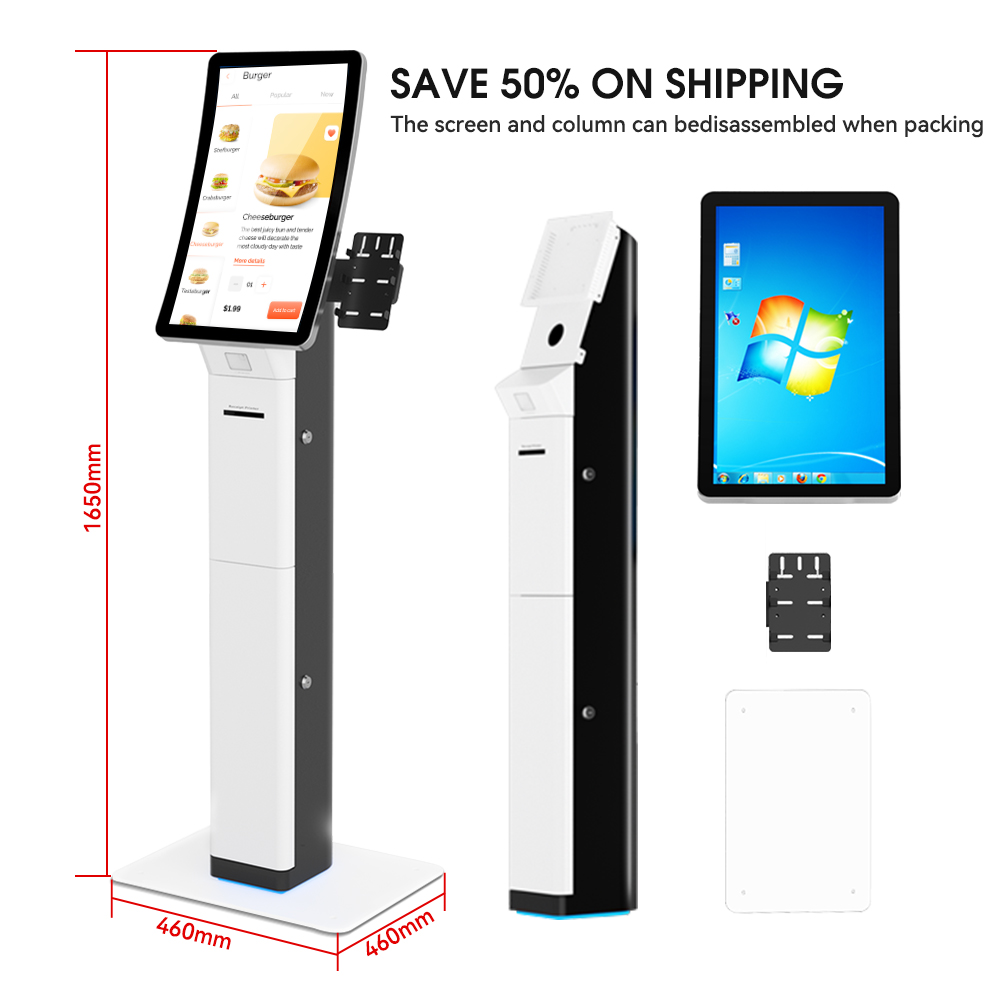
Quick answer: Short answer: When sourcing a self-service kiosk or cash-handling terminal as an OEM/ODM buyer in 2026, you cannot rely on a supplier’s word that a product “has certification.” The only defensible way to verify CE, FCC, RoHS and ISO 9001 is to (1) confirm the certificate belongs to the exact model and factory you are buying from, (2) match it to your target market’s specific requirements, and (3) collect the supporting documents, not just the decorative logo file. Below is a market-by-market checklist you can paste directly into your RFP.
Overview
Short answer: When sourcing a self-service kiosk or cash-handling terminal as an OEM/ODM buyer in 2026, you cannot rely on a supplier’s word that a product “has certification.” The only defensible way to verify CE, FCC, RoHS and ISO 9001 is to (1) confirm the certificate belongs to the exact model and factory you are buying from, (2) match it to your target market’s specific requirements, and (3) collect the supporting documents, not just the decorative logo file. Below is a market-by-market checklist you can paste directly into your RFP.
Why “we have all the certifications” is not an answer
Nearly every kiosk OEM claims certification compliance. The gap in the market is not a list of which certificates exist — it is how a buyer verifies them before signing . A certificate issued to a different model, a different factory, or for a different market does nothing to protect you from a customs hold, a market withdrawal, or a liability claim on your own branded product.
Three verification errors we see most often from buyers:
- Trusting a logo file. A supplier pastes “CE” or “FCC” on a datasheet without showing the underlying test report or certificate number.
- Mismatching the model. The certificate is for a similar unit, not the exact model/configuration you are ordering.
- Ignoring the market layer. FCC clears the US, but not the EU (CE-RED) or the Middle East (SASO). One certificate rarely covers all three.
How to read a real certificate vs. a decorative claim
A genuine certification is traceable. Ask for these four artifacts, not the logo:
| Artifact | What proves it is real | Red flag if missing |
|---|---|---|
| Certificate number | Searchable in the issuing body’s online database (e.g. TÜV, SGS, UL, BSI, Intertek) | Only a brand logo, no number to look up |
| Model list on the cert | Your exact model number appears on the certificate’s scope | Model differs even slightly from what you order |
| Manufacturing site | Factory address on the cert matches the plant doing your production | Certificate names a different or shell company |
| Test report + DoC | Declaration of Conformity signed by the legal manufacturer with standards listed | Supplier cannot produce the underlying report |
Market-by-market checklist
United States — FCC
Radio-emitting kiosks (Wi-Fi, Bluetooth, RFID, cellular payment) need FCC authorization. Verify the FCC ID on the device against the official FCC equipment-authorization database . Confirm it is the current grantee code and covers the exact module/configuration. Note: FCC compliance also carries responsibility for the party importing into the US — if you brand and import, understand your own obligations, not just the factory’s.
European Union — CE (RED + EMC + LVD) and RoHS
In the EU, the CE mark is a self-declaration backed by a DoC. For kiosks with radio modules this means RED (Radio Equipment Directive 2014/53/EU) ; for all electronics, the EMC and LVD directives plus RoHS substance limits under Directive 2011/65/EU. Ask the factory for the DoC listing the harmonised standards and the technical file. A CE logo without a DoC and technical file is a warning sign.
Middle East — SASO / local approval
Saudi Arabia and other GCC markets add their own schemes (e.g. SASO IECEE, Saber certification) on top of CE/FCC. If the Middle East is your target, explicitly ask whether the OEM holds the local country approvals, not just the EU/US ones.
ISO 9001 is about the factory, not the product
ISO 9001 certifies a quality management system , not a specific product. It tells you the factory has controlled processes. Verify it is current (issued within 3 years, valid surveillance), names the actual production site, and is issued by an accredited body. Pair ISO 9001 with product-level certs — it never substitutes for them.
Copy-paste RFP question template
Paste these questions verbatim into your RFP or RFQ to force verifiable answers:
- List the exact model numbers covered by each certificate you will ship, and the certificate numbers with issuing bodies.
- For my target market (specify US/EU/GCC), which approvals do you hold today? Provide the DoC and technical file for the model in question.
- Does the certificate name the factory site that will produce my order? Attach the scope page showing the address and models.
- For radio modules, provide the FCC ID and confirm it is active in the FCC database for my configuration.
- For the EU, which harmonised standards does your DoC cite (RED/EMC/LVD)? Share the DoC document, not a screenshot.
- Provide your current ISO 9001 certificate with the issuing body and site address.
- If I customise hardware (housing, modules, cash subsystem), what re-certification is required and who covers the cost and timeline?
- Who is the legal manufacturer and importer of record for my market — and what documentation do you supply for customs?
Verifying this documentary package is the first layer of a risk-managed buy. For the second layer — the approval documents themselves — see Kiosk Production Approval: 9 Documents a Factory Must Provide , which lists the exact paperwork to collect before production, and this freestanding cash-handling kiosk’s verification package for a worked example of the documents in practice.
Frequently asked questions
Can a supplier legally sell a kiosk without CE or FCC?
For the US, radio-emitting devices need FCC authorization before marketing and import; for the EU, radio equipment needs CE under RED before being placed on the market. A supplier claiming a device “works” without the relevant market authorization is a compliance risk for the buyer, not a small paperwork gap.
Does an ISO 9001 certificate mean the product is certified?
No. ISO 9001 certifies the factory’s quality management system, not the product. You still need product-level approvals (CE, FCC, RoHS) that apply to the specific model and market. Treat ISO 9001 as a process signal, not a substitute for product certification.
Is one certification valid in every country?
No. FCC authorises the US, CE covers the European Economic Area, and markets such as Saudi Arabia (SASO/Saber) add their own approvals. Always match the certificate set to your actual target market and check whether re-certification is triggered by hardware customisation.
Your next step
Certification is one layer of a risk-managed OEM/ODM buy. The right supplier gives you the full documentary package up front, not after you ask a second time. If you are evaluating a cash-handling or payment kiosk partner and want to see how a supplier documents approvals before you commit, review a cash-handling kiosk that ships with a configurable verification package , or request a quote or datasheet and we will send the verification package for our current production models.

