Quick answer: Cash acceptance is moving from a customer-experience choice to a statutory requirement. This buyer’s guide maps the 2026 mandates (Australia, New York, Illinois), what they force into a kiosk hardware spec, and how to de-risk procurement.
Overview
Quick answer. Cash acceptance is shifting from a customer-experience preference to a legal requirement. Australia mandates cash for in-person grocery and fuel purchases up to A$500 from 1 January 2026. New York State requires food stores and retail establishments to accept cash from 20 March 2026. Illinois’ Retail Cash Payment Act takes effect 1 January 2028. For kiosk and self-service projects, this means cash-handling hardware must be speced against a statutory threshold, not a preference, before launch.
Why the 2026 cycle is different
Until recently, “going cashless” was a merchant decision with a reputational cost. That is no longer true in a growing number of jurisdictions. At least 21 US cities and states have adopted or are actively considering cashless-retail bans, and the first national-level mandate has landed in Australia. For anyone procuring self-service kiosks, unattended payment terminals or cash-handling modules, the question has flipped: the burden is now on the operator to prove cash is accepted, at the right threshold, in the right conditions.
The commercial backdrop makes this more than a legal footnote. The Federal Reserve’s 2026 Diary of Consumer Payment Choice found that four out of five US consumers used cash in the previous 30 days, 90% plan to keep using it, and 76% carried cash in a pocket, purse or wallet in 2025 (average US$69). Cash is not disappearing; it is being legislated back into the specification .
The mandate map: what is actually in force
| Jurisdiction | Instrument | Effective | Scope / threshold | Penalty exposure |
|---|---|---|---|---|
| Australia | Treasury cash-acceptance regulations (Chalmers) | 1 Jan 2026 | Grocery and fuel retailers must accept cash for in-person transactions up to A$500; businesses under A$10M turnover are excluded under the exposure draft | Regulatory / enforcement by Treasury |
| New York State | Protection of Cash Payments (S4153A) | 20 Mar 2026 | Food stores and retail establishments may not refuse cash for in-person purchases and may not surcharge cash payers; bills larger than $20 need not be accepted | Up to $1,000 first violation, $1,500 each subsequent |
| Illinois | Retail Cash Payment Act (HB 4592) | 1 Jan 2028 | Retail establishments with an employee taking in-person payments may not refuse cash for sales under $500, nor post cashless-only signage | Statutory civil penalties (exceptions apply) |
| New Jersey | A591 | 2019 (in force) | Most businesses barred from rejecting cash | Up to $2,500 first offence, $5,000 second |
| Massachusetts | General Laws ch. 93 §10A | 1978 (in force) | Retailers may not discriminate against cash buyers | Statutory |
| Philadelphia / NYC / San Francisco / Berkeley | Municipal ordinances | 2019 – 2020 | Cashless-only retail prohibited within city limits | Municipal fines |
Note: there is still no US federal law requiring cash acceptance. Verify the current text and any amendments against the primary legislation before specifying a project — thresholds and effective dates have moved during drafting.
How a mandate changes the hardware spec
A mandate turns three previously optional design decisions into procurement gates. If the kiosk cannot accept, count and reconcile cash reliably, the operator is in breach regardless of how good the software is.
| Compliance requirement | What it forces into the spec | Failure mode if omitted |
|---|---|---|
| Accept cash up to a statutory ceiling (A$500 / $500) | Note and coin acceptor with validated denomation set and adequate hopper/stacker capacity for a full trading day | Unit stalls on high-value transactions; staff intervention defeats the self-service ROI |
| No surcharge for cash payers | Unified price display and payment flow — no card-only discounting logic in the UI | Perceived discriminatory pricing; complaint and penalty risk |
| Accept at a fixed daily window (Australia: from 7am) | Unattended uptime and remote monitoring so the terminal is live when legally required | Downtime inside the legal window is a compliance event, not just a service outage |
| Change/return correct value | Recycling or dispensing module sized to expected change demand; jam-resistant transport | Cash-out failures are the single most visible breach to a customer |
| Auditability | Reconciliation logging, cassette-level counts, tamper detection | No defensible audit trail if a regulator or auditor asks |
Scenario fit: which cash module for which deployment
| Deployment | Typical requirement | Hardware shape |
|---|---|---|
| Grocery / convenience checkout (AU, US) | High transaction frequency, note + coin, change return | Countertop change kiosk — e.g. US-K101CB-1 / US-K101CB-2 |
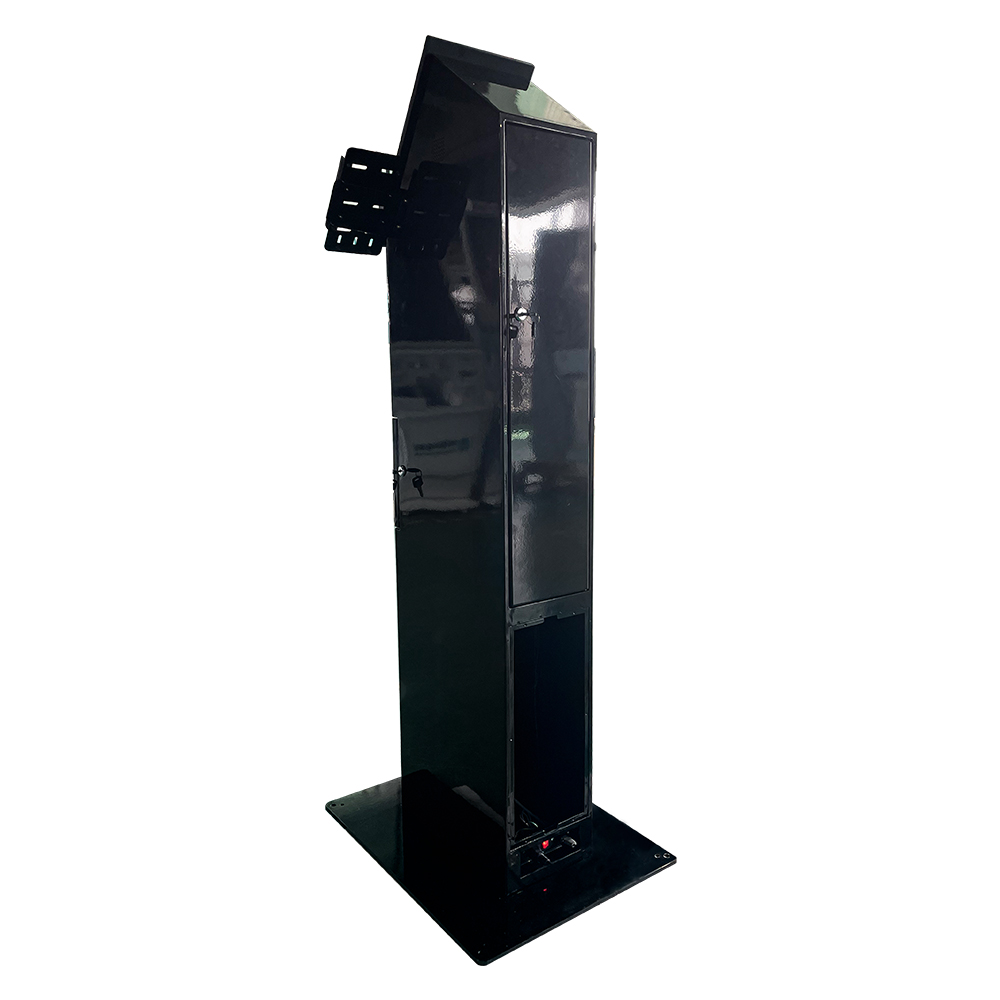
| Fuel forecourt | Rugged outdoor-adjacent enclosure, fast cycle, secure cassettes | Freestanding cash-handling kiosk — e.g. US-K215CB |
| Retail / mall self-service | Mid-volume, brandable enclosure, wall or floor | Freestanding or wall-mount — e.g. US-K236CB / US-K320WM |
| Hospitality, gaming, banking | High-value notes, dispensing, audit trail | Freestanding dispensing kiosk — e.g. US-K236CB, US-K320FS-3 |
Spec a recycler, not a deposit machine, whenever the site must give change. A cash recycler stores incoming notes and dispenses the same notes back as change; a cash deposit machine accepts one-way only. The recycle-versus-deposit decision therefore follows from the cash-flow shape of the site — specifically whether it pays change in the same shift it takes cash — and not from the mandate alone. Our cash recycling vs cash deposit machine guide sets out the full specification differences.
Risk and de-risking
| Risk | Why it bites | De-risk in the RFQ |
|---|---|---|
| Legislative drift | Thresholds and dates changed repeatedly during drafting (Illinois moved to 2028) | Spec to the lowest plausible threshold and require field-updatable denomination sets |
| Cash circulation clarity | Central banks differ on note fitness and acceptance rules | Confirm target notes against the operator’s bank/cash-in-transit provider |
| Jam-driven downtime | Each failure inside the legal window is a visible breach | Demand jam-rate data and a self-service purge routine |
| Integration risk | Cash module must talk to the POS/back-office and the reconciliation stack | Require documented APIs and a pilot-unit acceptance test |
| Long lead time | Mandate deadlines do not move for your supplier | Lock MOQ and lead time in writing before the compliance date |
How Usingwin fits a compliance-driven rollout
Usingwin builds cash-handling and self-service kiosks to order, and three commercial terms matter when a mandate sets your deadline. MOQ of 1 unit lets a single site validate a specification before a fleet rollout. Lead time is roughly 20 business days on countertop cash modules and 20–25 business days on larger freestanding units. And customization is configuration-based, so the note/coin set, hopper capacity, enclosure and branding are confirmed against the project rather than assumed. Manufacturing runs on an OEM/ODM basis from a configurable hardware, peripheral and branding platform.
Relevant platforms: US-K101CB-1 and US-K101CB-2 (countertop change kiosks), US-K215CB (freestanding cash handling), and US-K236CB (floor-stand dispensing). Product datasheets are available per model.
Next step
If you are specifying cash hardware against a 2026 mandate, send us your jurisdiction, transaction ceiling and expected daily volume. We will return a configuration recommendation, a datasheet and a lead time. Request a quote or sample unit .
Is cash acceptance legally required in the US?
Not federally. It is state- and city-level: New York State (from 20 March 2026), New Jersey, Massachusetts, Rhode Island and several cities have prohibitions on cashless-only retail. Illinois’ Retail Cash Payment Act is scheduled for 1 January 2028. Always check the specific jurisdiction.
What is the Australian cash mandate threshold?
From 1 January 2026, grocery and fuel retailers must accept cash for in-person transactions of A$500 or less, with small businesses under A$10M turnover excluded under the exposure draft.
Does a cash mandate apply to self-service kiosks?
Yes, in most covered jurisdictions. A cash-acceptance mandate is written against the transaction, not the checkout format: if a self-service kiosk completes an in-person sale within the statutory threshold — A$500 in Australia, $500 in Illinois, for example — and in a covered sector, the operator cannot refuse cash merely because the payment is unattended. The practical consequence is that the note and coin acceptor, the change/dispensing module and the reconciliation log become mandatory parts of the hardware specification rather than optional peripherals, and any downtime inside the legal trading window counts as a compliance breach rather than a routine service outage.
What lead time should I plan for?
Usingwin quotes roughly 20 business days for countertop cash-handling modules and 20–25 business days for larger freestanding kiosks, MOQ 1 unit. Plan backwards from your compliance date.
Sources
Australian Treasury, “Mandating cash acceptance” (ministers.treasury.gov.au); New York Attorney General press release on the Protection of Cash Payments law; Illinois HB 4592 / Retail Cash Payment Act (ilga.gov); Hunton Retail Law Resource, cashless-ban tracker; Federal Reserve Financial Services, 2026 Diary of Consumer Payment Choice. Product specifications from Usingwin product records.