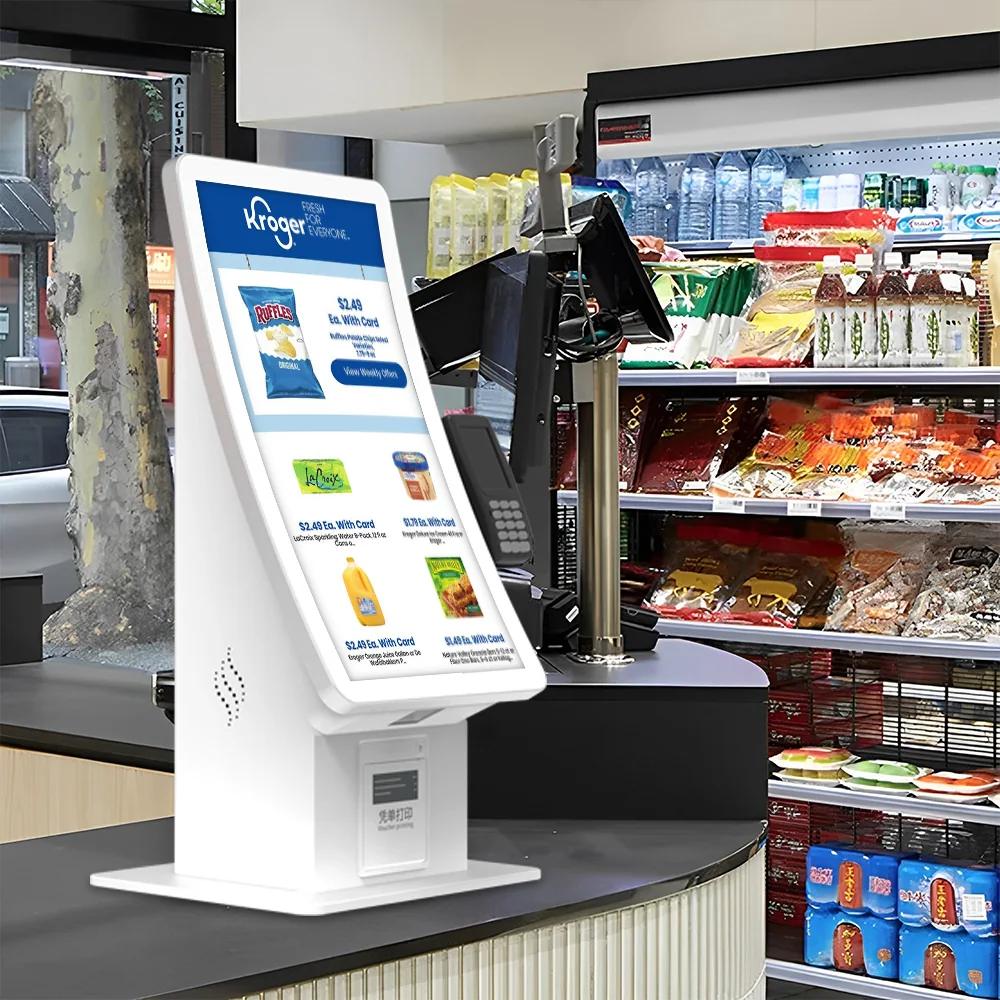

Quick answer: A procurement guide to kiosk accessibility compliance: the EAA timeline and its 2045 terminal cut-off, EN 301 549 hardware (reach, tactile controls, speech output, hearing-aid coupling) vs WCAG 2.1 AA software, the ADA/Section 508 picture in the US, the evidence to demand in an RFQ, and where deploy
Overview
Quick answer: Two separate regimes now gate a public-facing kiosk. In the EU, the European Accessibility Act (Directive (EU) 2019/882) has applied since 28 June 2025 and points to EN 301 549 v3.2.1 — WCAG 2.1 Level AA for the on-screen software, plus a hardware chapter covering reach ranges, tactile controls, speech output and hearing-aid coupling. In the US, the ADA and Section 508 require effective, independent use and are generally assessed against WCAG 2.1 AA. Buyers should demand an EN 301 549 test report and a current accessibility conformance report (ACR/VPAT) before freezing the cabinet — accessibility is a two-layer build, hardware and software, not a website checkbox.
Why the compliance window is open right now
The EAA is not a future deadline — it is an active one with long tail-offs that most kiosk buyers misread. The transition rules are the part worth reading twice:
| Milestone | Date | What it means for a kiosk project |
|---|---|---|
| Directive adopted | 28 June 2019 | Directive (EU) 2019/882 published in the Official Journal. |
| Member-state transposition | 28 June 2022 | National laws in force — e.g. Germany’s BFSG (Barrierefreiheitsstärkungsgesetz). |
| Requirements apply | 28 June 2025 | New products and services placed on the EU market must conform. |
| Service contracts agreed earlier | Until 28 June 2030 max | An existing contract may run out, but no longer than five extra years. |
| Self-service terminals already in use | End of economic life, max 20 years → 2045 hard stop | Legacy terminals may stay in service, but the next replacement or major software release must conform. |
| Microenterprise exemption | Ongoing | Applies to service providers under 10 staff / ≤ €2m turnover — it does not exempt the kiosk product a manufacturer or integrator sells. |
Three practical consequences: (1) a “we already have kiosks” argument buys time on hardware but not on software updates; (2) enforcement is national, so penalties vary — market-surveillance authorities can order fixes, block a service, or fine (Germany’s BFSG regime cites fines up to €100,000); (3) because conforming is a product property, the burden lands on whoever specifies the specification — usually the buyer’s tender document.
EAA and ADA are not the same job
Buyers running both EU and US sites often assume one accessibility spec covers both. It does not — the standards differ in legal basis, scope and remediation trigger:
| Dimension | EU — EAA / EN 301 549 | US — ADA / Section 508 |
|---|---|---|
| Legal nature | Directive (EU) 2019/882 — harmonising product & service requirements | ADA = civil-rights law (Title II public entities, Title III public accommodations); Section 508 = federal procurement |
| Technical benchmark | EN 301 549 v3.2.1 (Mar 2021), which incorporates WCAG 2.1 AA; hardware requirements in the standard’s hardware chapter | No single ADA kiosk standard yet — the US Access Board issued an ANPRM on self-service transaction machines (2022); DOJ has signalled a duty of effective communication through kiosks. Section 508 (federal) and standards such as WCAG 2.1 AA are the practical benchmark. |
| What triggers conformance | Placing a new product or service on the EU market; replacing/upgrading a legacy terminal | Providing goods or services through an inaccessible interface; Section 508 applies to federal acquisitions |
| Sector overlays | Banking, e-commerce, transport, telecoms, e-books | ACAA for air travel kiosks; ACA Section 1557 for healthcare kiosks; state laws (e.g. California, Colorado) |
| Typical evidence | EN 301 549 test report + accessibility conformance report | VPAT/ACR against WCAG 2.1 AA + remediation documentation |
If your kiosk fleet ships to both regions, write one accessibility requirement set against EN 301 549 v3.2.1 and use it for the US too — it is the stricter of the two on hardware, and WCAG 2.1 AA is the common software denominator.
What to certify: the two layers most projects under-scope
Accessibility exposure on a kiosk almost always sits in the layer the buyer forgot. Test both, separately, and name an owner for each:
| Layer | Governed by | What must be verified |
|---|---|---|
| Hardware | EN 301 549 hardware chapter (stationary ICT) + ADA reach-range requirements | Reach range for operable parts, screen position and legibility, tactile discernibility of controls, speech output level & control, hearing-aid coupling, a means for a user to enable speech output non-visually. |
| On-screen software | EN 301 549 software chapter → WCAG 2.1 Level AA | Screen-reader reachable controls, focus order, contrast, text resizing, timeouts with an extension path, no audio-only instructions, error identification. |
| Service / operation | EAA service obligations | Session reset that does not strand a user, a documented assisted path where self-service cannot complete, and staff trained not to treat assistance as a substitute for conformance. |
Hardware spec decisions to fix before tooling
These are the items that are cheap to design in and expensive to retrofit. Values below are drawn from EN 301 549 and ADA-related guidance — confirm the exact clause against the current standard text with your test lab:
| Requirement area | Spec direction to confirm | Why it is a tooling item |
|---|---|---|
| Reach range | Operable parts within an ADA-aligned forward reach band (commonly cited as 15–48 in / 380–1220 mm) — validate against your market’s rule | Drives screen height, card slot and cash-slot placement on the enclosure. |
| Screen legibility | Display visible from the reference viewing point (ADA guidance references a point 40 in above the centre of the clear floor space); characters with a minimum cap height and a sans-serif face; light-on-dark or dark-on-light contrast | Panel size, tilt and bezel are fixed at tooling. |
| Tactile operation | Physical keys/controls tactilely discernible; shared-use devices that can output speech provide a tactile means to activate the speech mode | Requires real buttons or a tactile overlay — not a pure glass touchscreen. |
| Speech output | Adjustable volume with a range of at least 18 dB and incremental control | Needs an amplified audio path and a physical control surface. |
| Hearing-aid compatibility | Magnetic coupling / telecoil compatible output where speech is provided | Audio module choice; hard to add after enclosure sealing. |
| Headphone / privacy | A standard audio jack or equivalent private-listening provision | Exterior port plus internal routing. |
| Audio-visual pairing | Where output is audio-only or visual-only, provide a corresponding visual or audible indicator | Indicator placement and UI work. |
Note: accessibility features are configuration items, not a single SKU attribute. A touch-only configuration and a tactile + speech configuration are different builds of the same cabinet, and the accessible variant usually changes the front panel, the keypad, the audio module and the software layer.
What to put in the RFQ
Ask for evidence, not adjectives. An accessibility claim without a document is not a claim you can defend to a market-surveillance authority:
- EN 301 549 test report covering both the hardware and software clauses, naming the standard version tested.
- Accessibility conformance report (ACR/VPAT) against WCAG 2.1 Level AA, with known limitations stated, not omitted.
- Accessible-configuration bill of materials : tactile keypad, speech module, headphone provision, screen height — so the accessible variant is orderable, not a one-off.
- The assisted-service fallback in writing: what a user does when self-service cannot complete the task.
- Contact path for accessibility feedback , since most national EAA implementations require one.
Where deployments actually fail
| Failure | Why it happens | De-risk move |
|---|---|---|
| Buyer certifies the website, not the kiosk | Teams reuse the web accessibility audit and assume it covers the terminal | Scope the EN 301 549 hardware clauses explicitly; a WCAG audit alone is not sufficient. |
| Tactile access retro-fitted | Touchscreen-only configuration approved first | Decide the accessible variant at concept stage; it changes the front panel. |
| Screen reader works, but the journey does not | Software audited in isolation from the hardware timeout/reset behaviour | Test the full task end-to-end in the accessible configuration, on the real cabinet. |
| Legacy fleet assumed exempt forever | Transition relief mistaken for permanent exemption | Track terminals against the 20-year / 2045 ceiling and require conformance at replacement. |
| Accessibility added to one region only | Separate EU and US specs diverge | Use EN 301 549 v3.2.1 as the single global requirement set. |
How this maps to the hardware
Usingwin builds self-service kiosks as OEM/ODM enclosures — the accessible configuration is part of the project specification, confirmed per configuration rather than assumed. Formats commonly specified for accessible public-facing deployments include:
- US-K320FS-2 — 32 in freestanding cabinet used for hotel & hospitality check-in (lead time 20–25 business days)
- US-K236FS-2 and US-K236 — curved-screen counter/multi-mount formats for food & beverage and retail (15–25 business days)
- US-K215FS-1 — 21.5 in floor/desktop dual-mount (lead time 15 business days)
- US-K320WM — 32 in wall-mount for retail (15–20 business days)
- US-K101CB-1 / US-K101CB-2 — 10.1 in cash-handling units for counter-top payment and change
- US-K236CB-2 — currency exchange cabinet for banking/finance and travel
MOQ 1 unit on standard formats — a single accessible evaluation unit can be built before a fleet order. Enclosure dimensions, mounting, keypad, audio and peripheral scope are confirmed per project configuration.
→ Request a quote, an accessible-configuration sample, or an accessibility test plan through our contact page , or start from the OEM/ODM project brief . Tell us the market (EU / US) and the task the kiosk must complete and we will return a configuration proposal with the accessibility options called out as separate line items.
Is a self-service kiosk covered by the European Accessibility Act?
Yes. Self-service terminals used in the provision of services within the EAA’s scope are covered, and the technical benchmark is EN 301 549. Terminals already in service before 28 June 2025 may continue until the end of their economic life, capped at 20 years (2045), but a replacement unit or a major software release must conform.
Does EN 301 549 mean WCAG 2.1 AA is enough for a kiosk?
No. WCAG 2.1 AA, adopted via the software clauses, covers the on-screen interface only. EN 301 549 additionally imposes hardware requirements — reach ranges, tactile controls, adjustable speech output and hearing-aid coupling — that a WCAG audit does not test. A kiosk needs both layers verified.
What is the difference between the EAA and the ADA for kiosks?
The EAA is an EU directive that sets product and service requirements against EN 301 549. The ADA is US civil-rights legislation with no dedicated kiosk technical standard yet; DOJ has focused on a duty of effective communication, and Section 508 applies to federal procurement. In practice EN 301 549 + WCAG 2.1 AA is the requirement set that satisfies both, so most international buyers specify it once.
Do small companies have to comply?
The EAA’s microenterprise exemption covers service providers under 10 staff and ≤ €2m turnover — it does not exempt the product a manufacturer or integrator places on the market. Enforcement, penalties and any national carve-outs are set per member state; confirm the position for each country you ship into.
Can accessibility be added to a kiosk after it is built?
Partly, and expensively. Software-level fixes (contrast, focus order, timeout handling) are usually feasible. Hardware-level items — tactile controls, speech output, headphone provision and screen height — change the front panel, keypad and audio module, so they should be decided before tooling.