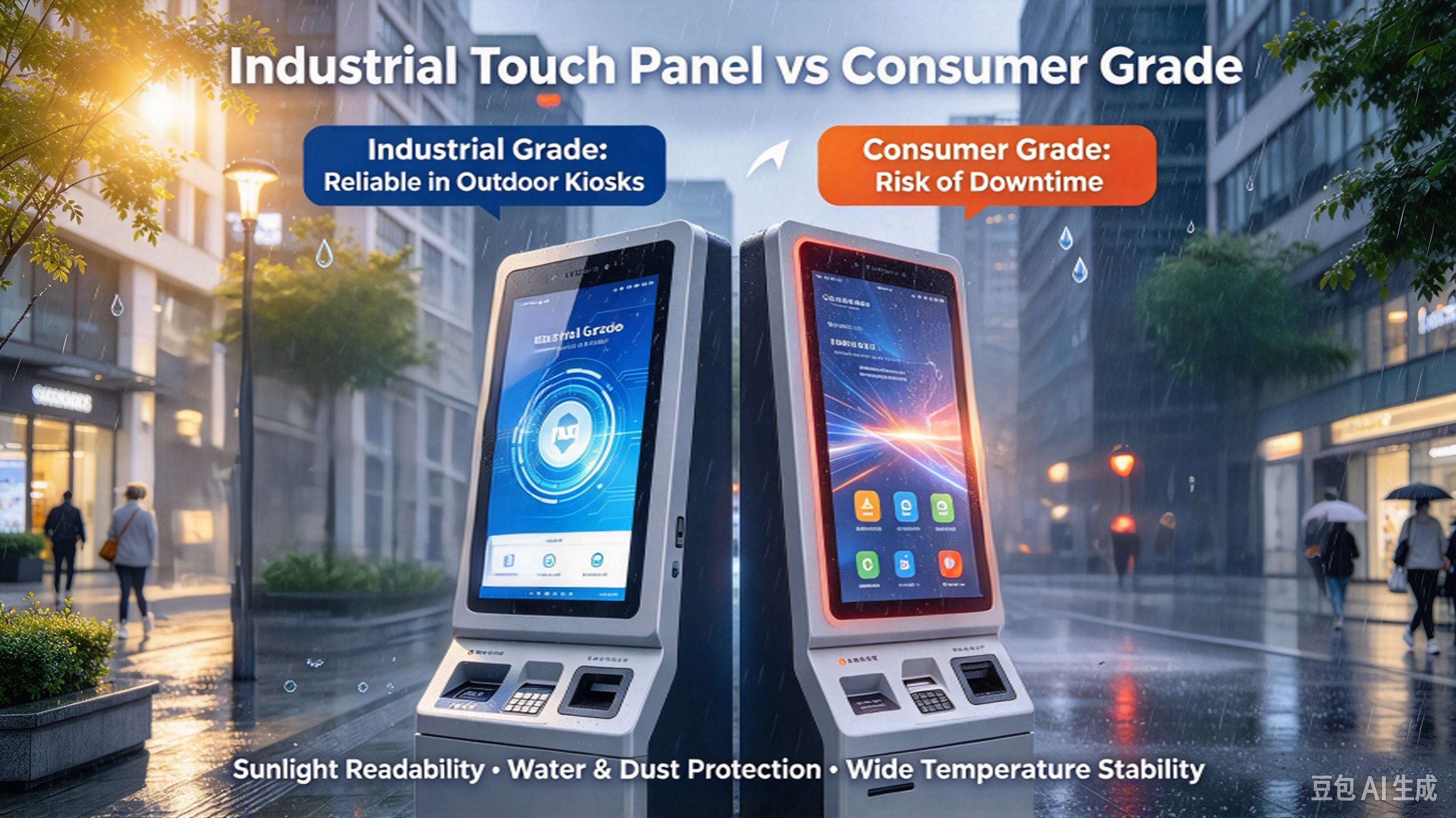
Quick answer: Industrial-grade touch panels pay back on unattended sites exposed to rain, dust, direct sun, salt air or sub-zero nights, where each failure means a truck roll and dead transaction hours. On a covered, climate-controlled, attended floor the same premium is usually not worth paying — the failure modes it prevents largely do not occur there.
Consumer-grade vs industrial-grade: the comparison that decides the purchase
Read this table by the third column. A spec that has no consequence attached to it is a spec you should not pay for. Where a value is grade-dependent, treat it as verify with the supplier’s test report rather than accepting a datasheet headline — more on that below.
| Parameter | Consumer-grade display in an outdoor enclosure | Industrial-grade panel | Consequence for the buyer |
|---|---|---|---|
| Sealing / ingress | Panel itself is not sealed; protection depends entirely on the enclosure and gasket work | Sealed assembly engineered and tested as a unit; sealing travels with the panel | Consumer grade shifts all ingress risk onto your enclosure vendor and your field gasket quality |
| Operating temperature range | Typical commercial comfort band | Wider operating band, stated with test duration and gradient | Determines whether your site works on a winter morning or a sun-loaded afternoon — ask for the test method |
| Storage temperature range | Rarely published | Usually published separately from operating range | Governs whether a unit survives being warehoused or shipped unheated, not just powered on |
| Sunlight readability | Brightness chosen for indoor rooms; glossy front glass | Higher brightness plus anti-glare treatment and optical bonding | Washout causes mis-taps, which users read as “the machine is broken” |
| Input under gloves / wet fingers / rain | Sensitive to surface water films; often unreliable with gloves | Tuned to reject water films and to register gloved input | Drives abandonment at exactly the moment the user is standing in bad weather |
| EMC robustness | Designed to consumer emission limits | Designed against the IEC 61000 series framework | Matters where the kiosk shares power or proximity with motors, pumps, dispensers or heavy switching |
| Backlight & controller lifetime | Rated for intermittent home/office duty | Rated for continuous duty, with a stated figure and test basis | Drives your replacement-spares budget over a multi-year deployment |
| Warranty stance | Typically voids on outdoor, 24/7 or unattended use | Usually written to cover commercial deployment, with named exclusions | Read the exclusions, not the warranty length — an outdoor-void warranty is the real price signal |
| Indicative cost delta | Lower unit price | Higher unit price | Size it against avoided dispatches, not against the panel line item |
If your project is still deciding between touch technologies before grade, the separate question of sensitivity, sealing behaviour and glove performance by technology is covered in our capacitive vs infrared touchscreen selection guide — grade and technology are two independent choices, and the wrong grade cannot be rescued by the right technology.
Failure modes consumer panels hit outdoors — and what each one costs per site
These are the failure patterns worth costing before you approve a premium. For each one, the second line tells you what an operator notices first, which is how you detect the trend before it becomes an outage.
- Capacitive drift and ghost touches after condensation or pooled water. Users tap and the cursor jumps, or the panel registers touches nobody made. Cost: repeat transactions, refund disputes, and a diagnostic visit where the technician cannot reproduce the fault indoors. Detect early: a slowly growing dead zone or an input that needs several presses to register.
- Edge ingress and delamination. Moisture works in at the glass edge or a field-cut aperture; the touch layer separates from the display. Cost: panel replacement, plus the labour to re-seal and re-commission. Detect early: visible clouding or a bright halo line along one edge.
- Input collapse on gloved or wet fingers. The panel works in the workshop and fails in a cold or rainy forecourt. Cost: queue abandonment at the busiest hour, with no error code to alert your monitoring. Detect early: support tickets clustered by time of day or weather rather than by site.
- Sunlight washout driving mis-taps. The screen is legible enough to read but not to aim at. Cost: wrong-item selections, refunds, and users who never return. Detect early: transaction error rates that peak in the afternoon and recover after dark.
- Thermal failure at cold extremes. The unit boots then freezes, or the display responds slowly until it self-heats. Cost: a morning outage window that coincides with peak commuting demand. Detect early: uptime logs showing a repeatable cold-start window.
- Bonding and adhesive degradation. Optical bonding yellows or releases, taking readability and sometimes touch accuracy with it. Cost: the slowest failure to justify to finance, because the unit still “works”. Detect early: gradual contrast complaints from field staff.
- Electromagnetic interference near motors and dispensers. Intermittent unresponsive periods that vanish when the technician arrives. Cost: the most expensive diagnosis you can buy, because intermittent capacitive faults rarely reproduce on a bench. Detect early: log the exact times, then check what else on site runs at those times.
Deliberately absent from that list: any failure-rate percentage. Nobody can give you an honest one for your site — exposure, mount orientation, cleaning regime and user behaviour dominate the numbers. Estimate from your own data instead: count touch-related service events per unit per year across your existing fleet, or across a comparable site you operate, and use that as your baseline before committing to a volume.
What “industrial” should actually mean on a datasheet
“Industrial” is a marketing word. These are the parameters that turn it into something you can hold a supplier to.
- IP rating, and its scope. IEC 60529 is the framework behind the IP code, and it applies to the tested sealed assembly — not to a bare panel sitting behind your own sheet metal. This is the single most misread line in outdoor kiosk procurement. A panel rated for a sealed enclosure is not rated once you cut a cable aperture through it or re-use a compressed gasket after service.
- Operating vs storage temperature, separately. The test duration and gradient matter as much as the endpoints; a brief excursion rating and a sustained operating rating are different claims.
- Humidity and condensation exposure. Especially the behaviour of the touch stack when moisture is on the inside of the glass, not just the outside.
- Optical bonding, brightness and anti-reflective treatment. Ask how they were specified — against outdoor ambient light, or against an indoor showroom.
- EMC to the IEC 61000 series. Relevant wherever the kiosk shares infrastructure with motors, pumps or heavy switching loads.
A credible industrial datasheet should disclose the test method behind the IP claim, the duration and gradient of the temperature test, and the touch controller’s reported behaviour under moisture. Plenty of datasheets omit all three. Five questions to email any supplier before shortlisting:
- What third-party test report supports the IP rating, and does it cover the complete sealed assembly as installed?
- What are the operating and storage temperature ranges, and over what duration and gradient were they tested?
- What is the panel’s documented behaviour with water on the surface and with gloves on — a test result, not a claim?
- What brightness and optical bonding were specified for outdoor ambient light, and against what measurement?
- Which warranty exclusions apply to outdoor, unattended or 24/7 deployment?
A datasheet claim that cannot be matched to a supplier-supplied test report is a claim, not a specification. This is a document request, and it is normal to make it.
Match the grade to exposure — not every site needs the upgrade
Grade selection is a per-site decision, and a portfolio will contain more than one answer. Add the right line items to each RFQ.
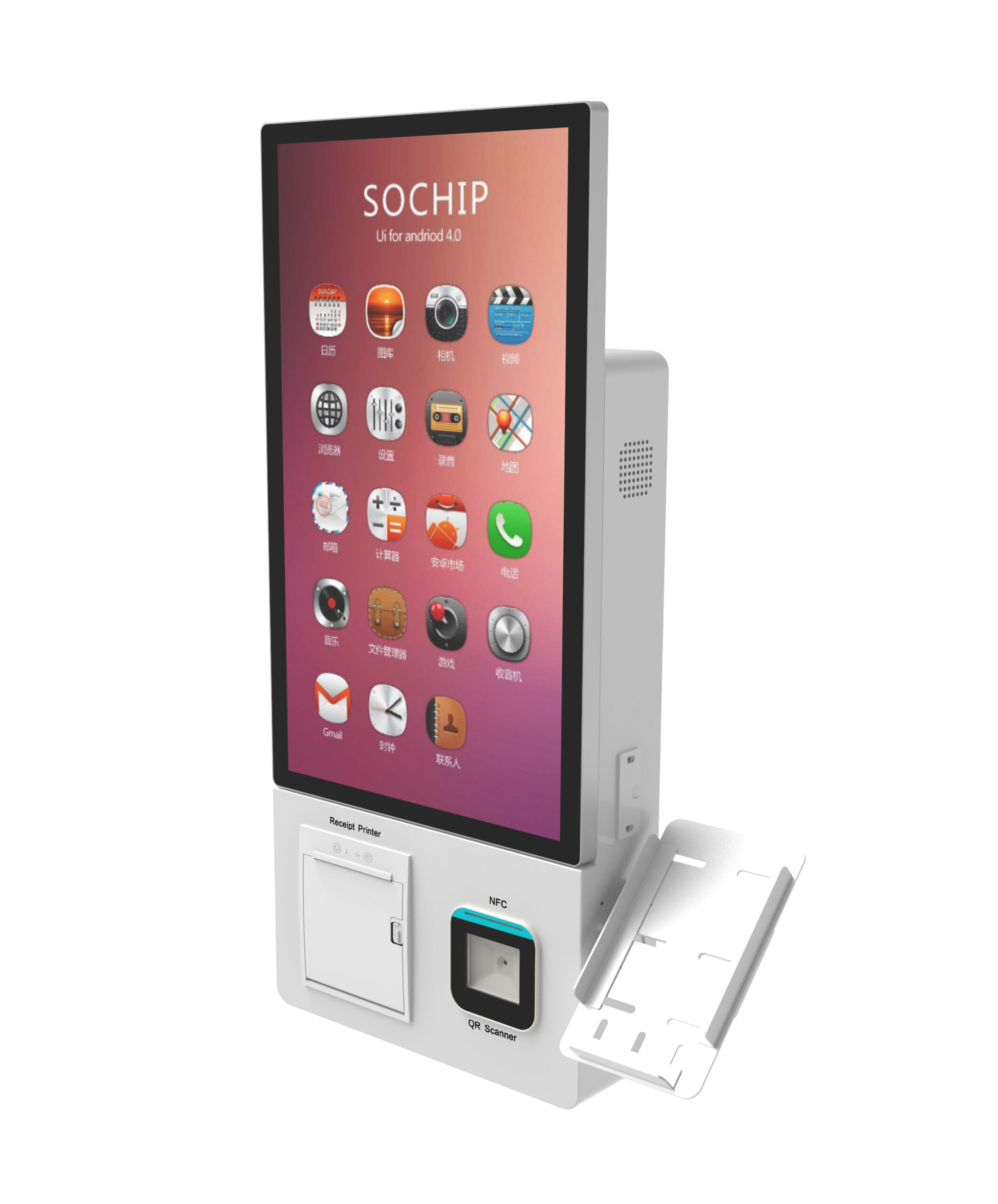
- Covered, climate-controlled, attended indoor floors (lobbies, branch interiors, staffed counters). Consumer or light-commercial grade is frequently the rational choice. There is no rain, no direct sun, no salt fog, and a person is on site when something goes wrong. Spend the saved budget on transaction hardware instead. Wall-mounted units for these positions are the lower-cost path — see the wall-mount self-service kiosk configuration.
- Unshaded plazas and high-traffic transit platforms. Industrial-grade panel with optical bonding, sunlight-legible brightness and a stated wide operating range. Add optical bonding and anti-glare as explicit RFQ line items, not as assumptions.
- Coastal and salt-fog sites. Salt fog is its own test regime — a general IP claim does not cover it. Add salt-fog-resistant sealing and corrosion-treated exposed hardware to the requirement list.
- Cold storage and sub-zero forecourts. Specify the low end of the operating range and the cold-start behaviour separately; a panel that works once warm is not a solution for a morning peak.
- Fuel, parking and unattended payment sites. These combine weather, vibration and shared electrical loads. Treat EMC and ingress together, because the symptoms overlap and diagnosis is expensive.
Validation checklist before you commit volume
- Field-trial at the real exposure. Install a sample at the actual site — not a demo room — for a period long enough to cross a full weather cycle, with pass/fail criteria written down before it starts.
- Demand the test report behind each IP and temperature claim, and confirm the chamber, method and scope match what you are buying.
- Read the warranty exclusions. Ingress through unsealed cable entries, incorrect mounting, physical abuse and UV-related degradation are common carve-outs — and several of them are exactly the outdoor failure modes you are paying to prevent.
- Confirm spare-panel availability and in-region lead time. Model the replacement path before you model the failure rate.
- Validate the touch controller and driver stack on your actual software platform before scaling, including under moisture and gloved input.
State the limits honestly to your own stakeholders: no panel grade survives every environment, an IP rating is voided by a field-cut aperture or a re-used gasket, and the warranty will not cover ingress through an unsealed cable entry or damage from a bad mount. Industrial grade reduces a defined set of failures; it does not remove the need for correct installation.
Next step: get the spec sheet and size your outdoor project
Industrial grade removes ingress, condensation, thermal and sunlight-driven touch failures — and it does not fix a poorly sealed enclosure, an unsealed cable entry or an intermittent fault you never diagnosed.
Review the hardware platform and configuration options on our freestanding cash-handling self-service kiosk page, which covers the enclosed, unattended deployment pattern most outdoor projects end up specifying.
Request the industrial touch panel spec sheet and reliability statement to size your outdoor deployment — including the test method behind each IP and temperature claim, the warranty exclusions for unattended outdoor use, and a field-trial sample so you can validate at your own site before committing to volume.