Quick answer: The short answer: a kiosk is genuinely field serviceable only if the vendor can name which components are field-replaceable units (FRUs) with part numbers, state the tool and skill level a swap requires, specify the connector and mounting standard at the module interface, and ship a maintenance manual and spare-parts list with the unit. If any of those four items is missing, “modular” is an adjective, not an engineering decision — and your shortlist score should treat it as unverified.
Overview
The short answer: a kiosk is genuinely field serviceable only if the vendor can name which components are field-replaceable units (FRUs) with part numbers, state the tool and skill level a swap requires, specify the connector and mounting standard at the module interface, and ship a maintenance manual and spare-parts list with the unit. If any of those four items is missing, “modular” is an adjective, not an engineering decision — and your shortlist score should treat it as unverified.
This page cannot verify any vendor’s service-time, mean-time-to-repair (MTTR) or uptime figures, and it deliberately does not assert them. Whatever the vendor claims numerically belongs in their written RFP response, where it is attributable, dated and contractually relevant. What follows is a checklist of questions, clauses and hands-on checks that turn those claims into something you can score.
Why serviceability claims swing your shortlist score more than the spec sheet suggests
Screen size, processor and enclosure finish are comparable across vendors in a way that serviceability is not. Modularity decides three operational facts that no datasheet row captures: who is allowed to fix the unit, which part they need in hand, and whether the site keeps trading during the repair.
Two vendors can both print “modular design” and mean very different things. One may define a module as a field-replaceable assembly a trained on-site technician swaps with standard hand tools. The other may define a module as a sub-assembly that must be returned to the factory, leaving your site with a closed unit and a shipping label. Both statements are technically true. Only one changes your escalation model.
This asymmetry is the leverage you have at shortlist stage: the vendor knows exactly how their enclosure is built and how much of that they choose to publish, and you do not. Ranking pages on this topic usually list modularity benefits — easier upgrades, faster repair, lower downtime — and then illustrate them with a single product. Useful vocabulary, weak verifiability. Treat every benefit claim as a question to be answered in writing, and the checklist below becomes a filter rather than a reading exercise.
Seven questions that separate real modular design from marketing language
- Which components are defined as field-replaceable, and is there a published FRU list with part numbers? A module you cannot order by part number is not a spare part; it is a conversation.
- Does removing a module require specialised tooling, calibration or a certified technician — or standard hand tools? The answer determines whether your front-desk or site staff can act, or whether every fault becomes a scheduled service visit.
- What is the module-to-chassis interface: connector type, mounting standard, and is it keyed or colour-coded to prevent mis-fit? Keyed interfaces reduce wrong-part installation, which is the most common failure mode of delegated field repair.
- Is the bill of materials for a module shared across other models in the vendor’s range, or unique to this SKU? Shared modules shrink the spare-parts inventory a multi-site fleet must carry.
- Does replacing a module require re-certification, re-sealing or a firmware re-provisioning step on site? Any of these can silently convert a field swap back into an engineer visit.
- Are fault diagnostics exposed to on-site staff — status LEDs, error codes, a self-test routine — or only to the vendor’s remote tooling? Diagnosability is half of serviceability; a swap nobody can trigger is wasted modularity.
- What documentation ships with the unit: maintenance manual, exploded diagram, spare-parts catalogue, or none? Ask for the actual documents as a delivery condition, not a summary of them.
Record each answer as “vendor-stated — verify against sample unit or documentation.” Do not close a shortlist decision on a verbal answer given in a call.
RFP clauses to demand (with placeholders for the vendor’s own numbers)
The clause language matters less than the placement: put these in the technical annex so the response becomes a scored document rather than a brochure. Leave every numeric field blank and require the vendor to complete it.
| Clause | What you require in writing | Vendor’s numbers |
|---|---|---|
| FRU definition | A list of field-replaceable modules with part numbers and itemised unit pricing | ___ |
| Tooling and skill | Minimum tool set and whether an operator or certified technician is required per swap | ___ |
| Interface specification | Connector and mounting standard per module; the IP rating that applies at the module interface (not only to the sealed enclosure) | ___ |
| Documentation | Maintenance manual and exploded diagram delivered with the unit as a delivery condition | ___ |
| Spares | Stated spare-part availability period and lead time per FRU | ___ |
| Diagnostics | Which faults are visible on-site and through which indicator; what remains vendor-side only | ___ |
| Certification scope | Which certifications apply to which module, and whether a module swap affects them | ___ |
Note the certification row carefully. Payment, cash-handling and access-control components may carry approvals tied to a specific configuration, and a field swap can move the unit outside the configuration that was approved. Ask the vendor to state the scope in writing, and confirm any residual obligation with the certification body or acquirer rather than relying on the vendor’s summary.
What to verify hands-on before you shortlist
Ask for a sample or demonstration unit and perform one module swap yourself. Time it only to record your own labour for internal comparison — not to publish or repeat a vendor figure, and not to substitute for the vendor’s contractual numbers.
- Cable routing and strain relief. Inspect the interface. A module that is electrically swappable but mechanically fragile — connectors hanging on their own weight, no service loop — is not field serviceable.
- Post-swap steps. Check whether the replacement needs a mating-part reseat, firmware pairing, a gasket or seal replacement, or a calibration pass before the unit returns to service.
- Access panel coverage. Confirm whether the wear-prone interior parts are reachable from a common access panel or require partial disassembly of the enclosure.
- Tool and label reality. Note the tools you actually needed versus the tools the manual specifies, and whether labels, wiring diagrams and torque markings are visible from the working position.
- Record keeping. Photograph and label every step. This record becomes your objective comparison across shortlisted vendors when spec sheets converge.
Red flags that usually mean “modular” is decorative
- No published FRU list or part-numbered components anywhere in the response pack.
- Serviceability described only with adjectives — “easy”, “quick”, “tool-free” — never with tooling, skill level or interface detail.
- Module boundaries drawn around cosmetic panels rather than around wear-prone components.
- Spare parts quoted only as a complete assembly, forcing replacement of working sub-components.
- Diagnostics that route every fault to the vendor, so your site still waits on a service visit even after you stock the part.
- Answers that change between the sales conversation and the written annex. The written annex governs.
Where this bites hardest: cash-handling and check-in deployments
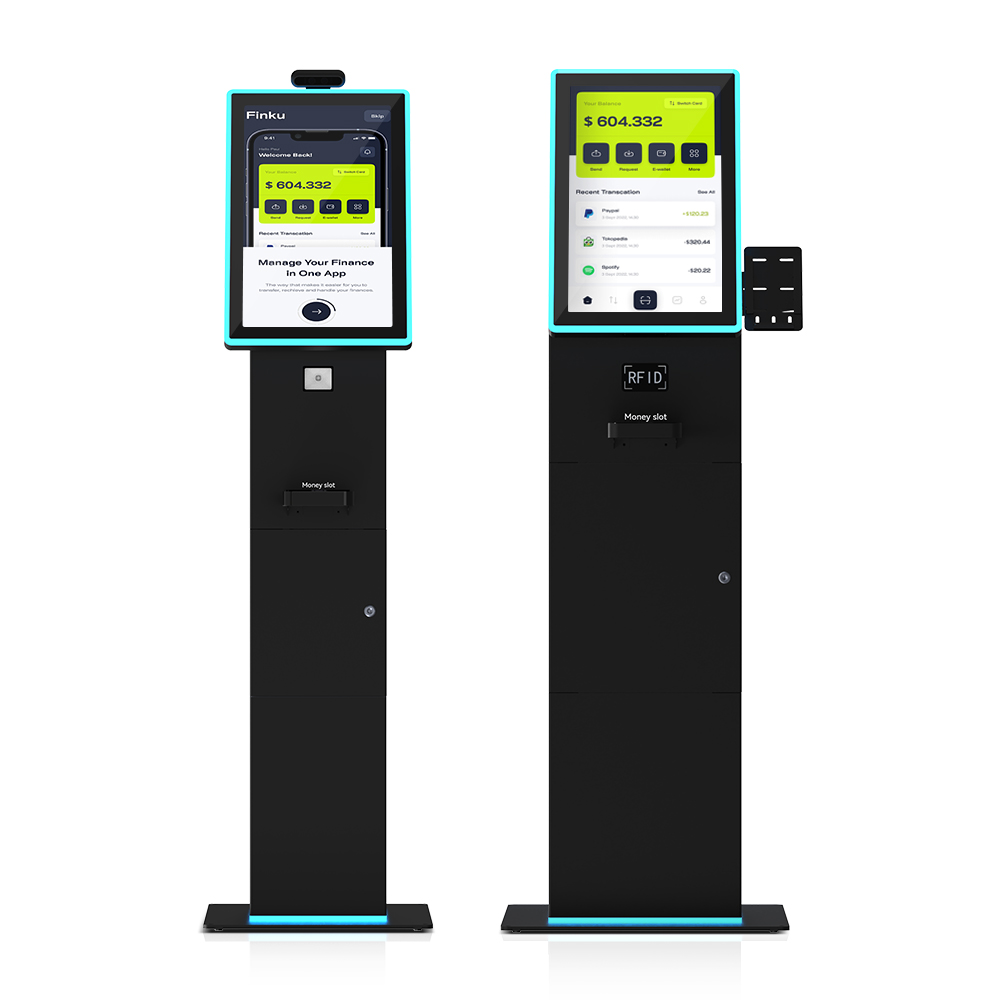
Wear is not distributed evenly inside a kiosk. Cash-accepting and cash-recycling units concentrate mechanical wear in the note path, so ask separately which cash-path components are FRUs and which are factory-return items. A freestanding cash-handling self-service kiosk and a currency exchange kiosk may look comparable on the outside while drawing their module boundaries in very different places — one at the note transport, the other at the whole cash unit. If the vendor cannot name that boundary in the payment or cash path, that is itself the answer.
Hospitality and casino check-in deployments face a different constraint: the unit sits in a lobby where downtime is visible to guests. If a module swap can be performed by front-desk staff with documented tools, your escalation model changes from “book an engineer” to “swap and log”. Our hotel check-in kiosk PMS integration and deployment guide covers the software side of that model; the hardware side is the FRU question above.
For multi-site rollouts, ask whether the same module SKUs serve the whole fleet. Mixed interfaces across sites multiply the spare-parts inventory you must hold and reduce the chance that a part taken from one site fits another. That inventory cost is part of the ownership picture, which is why it is worth reading alongside a kiosk total cost of ownership analysis — the unit price is rarely the deciding line once spares and site labour are included.
How to fold the answers into your vendor scoring matrix
- Add three weighted rows: FRU coverage (share of wear-prone components that are field-replaceable), swap skill and tool requirement, and documentation completeness.
- Score only written responses. Undated, unattributed or verbally delivered claims score as absent.
- Use your hands-on swap record as the tie-breaker between vendors whose brochures read the same.
- Treat a declined question as a penalty, not a neutral result — a non-answer is information about the supply relationship you are about to enter.
- Carry the scored matrix into commercial negotiation as the basis for spares pricing, warranty terms and support commitments.
Questions buyers ask at this stage
What makes a kiosk module truly field serviceable rather than just removable?
Three things together: it is orderable as a part number, it can be replaced with a stated tool set by a stated skill level, and the unit can be returned to service without factory intervention, calibration or re-certification you cannot perform on site. Removability alone proves none of that.
Should I ask for MTTR figures when evaluating modular kiosk design?
Ask, but treat the response as a vendor commitment to negotiate rather than a benchmark to compare. MTTR depends on your site’s response logistics as much as on the hardware. More useful components of the answer are the swap steps required, the diagnostics available on site, and whether the FRU is stocked locally or shipped.
Do field-replaceable cash-handling modules affect compliance certification?
Possibly, depending on the module and the certification scope. Require the vendor to state which approvals apply to which module and whether a swap changes the approved configuration, then confirm any residual obligation with the certification body or your acquirer. Do not accept a general assurance that the unit “is certified”.
How many spare modules should a multi-site operator stock per kiosk fleet?
That depends on your failure history and acceptable downtime, so no universal ratio applies. Use the vendor’s stated lead times and FRU availability period to model a stock level, and make those two figures contractual rather than assumed.
Next step
Consolidate the answers you receive into a single requirements annex, issue it with the RFP, and require every shortlisted vendor to respond against the same clauses. Then compare module-to-module rather than unit-to-unit, and book a sample-unit evaluation before signing — the swap you perform and document is the only serviceability evidence that is fully yours.
Request the field-serviceability spec sheet and modular component list for the models on your shortlist, including the field-replaceable module breakdown, interface details and spare-parts documentation. Bring your checklist, and we will answer it in writing so it can go straight into your scoring matrix.