
Quick answer: The short answer: a mixed-stock redemption deployment rarely fails because the scanner cannot read a barcode. It fails because the reader and the redemption logic were specified as one decision. Reader optics decide whether a faded thermal ticket or a dim phone screen decodes; redemption logic decides whether the same credential can be paid twice, especially while the kiosk is offline. Split those two questions, test them separately against your own ticket stock, and most of the risk in this purchase disappears before the purchase order exists.
Overview
The short answer: a mixed-stock redemption deployment rarely fails because the scanner cannot read a barcode. It fails because the reader and the redemption logic were specified as one decision. Reader optics decide whether a faded thermal ticket or a dim phone screen decodes; redemption logic decides whether the same credential can be paid twice, especially while the kiosk is offline. Split those two questions, test them separately against your own ticket stock, and most of the risk in this purchase disappears before the purchase order exists.
That split is also where this page differs from the vendor product pages and feature explainers that dominate the topic. Those list scanner types, walk through redemption steps and sometimes show a live payout video. They rarely hand the integrator an acceptance-test protocol for aged mixed stock, an idempotent offline queue design, or a reconciliation procedure for the moment the network comes back. Those three artifacts are the deliverable of this page — the scanner module is only the input to them.
Design against the failure that costs money: one ticket, two payouts
Two failure modes need separate language, because they carry different costs and are fixed by different parts of the system.
- False rejection is an optics or decoding problem — a valid ticket the reader refuses. The cost is queue friction, staff overrides and a guest who now believes the machine is broken. Operator commentary on redemption kiosks regularly cites jams, counting errors and general unreliability as the practical pain points rather than the headline feature set (Redplum Games, vendor/practitioner blog commentary, not benchmark data: redplumgames.com ).
- False acceptance is a logic problem — the same credential paid twice, whether from a screenshot replay, a retried request, or a queue that synced a locally-paid event that the server also authorized. There is no optics fix for this; it is a state-machine and idempotency question.
So the acceptance criteria you write before comparing reader modules should cover five things, in this order: which credential types and symbologies must be supported, how duplicates are detected, what happens offline, what the audit log contains, and how much integration work the supplier expects your team to absorb. Notice that only the first is a scanner question.
Audit the credential mix before you talk to any scanner vendor
Most failed evaluations begin with a clean demo ticket. Build the inventory first, per credential type rather than averaging everything into one “sample.”
| Credential | What to record | Where it typically breaks |
|---|---|---|
| Legacy 1D barcode on thermal paper | Symbology, print method, age, storage, damage pattern | Contrast loss and quiet-zone damage from folding or curling |
| 2D code on card stock or wristband | Substrate, lamination, wear at the crease | Specular reflection, edge wear, partial occlusion |
| Phone QR / mobile eTicket | Device models in use, typical brightness, screen protectors, cracked glass | Emissive surface plus glare; screenshot replay |
| NFC card or wristband | UID-only or secure element; account lookup path | UID identifies a token, not a balance or entitlement |
| Magnetic-stripe membership | Wear from wallet storage, track format, encoder age | Read failure on worn stripes; no fallback path |
Photograph representative good, faded, folded and damaged specimens for each row. A supplier who has only seen pristine samples cannot price or specify the risk you are actually carrying. Convergence’s public description of redemption scanning covers barcoded tickets and memberships across paper, wristband, card and mobile eTicket formats ( convergence.net ) — useful as a statement of what credential diversity looks like in the field, not as evidence that any given module reads your stock.
For the wider module set around the reader — dispenser, validator, cash box, receipt printer — work from the cash redemption kiosk BOM checklist . This page stays on the credential-reading layer only.
Legacy paper: where barcode reading actually fails
1D and 2D symbologies behave differently on damaged stock, and the difference matters commercially: if your operator can migrate stock, a 2D-only path is simpler; if arcade floors, third-party ticket suppliers and legacy cabinets keep producing 1D, you must support both indefinitely, and the reader specification changes accordingly.
Thermal fade is a contrast and bar-edge-definition problem, not something you can judge by holding the ticket under office lighting. Test three conditions separately:
- Faded but flat — tests the decode threshold on low contrast.
- Folded, creased or crumpled — tests whether the reader tolerates the ticket a guest actually pulls out of a pocket.
- Dirty, torn or partially occluded — tests mechanical handling as much as optics.
That last point is where optics and mechanics meet. Damaged stock creates jam and feed risk, which is a transport and workflow issue rather than a scanner datasheet line. If barcode print quality can be graded before deployment, ask for verification data or run a verifier — a scan/no-scan demo tells you almost nothing about how much margin is left in a stock of tickets six months older.
Phone QR: an emissive, reflective surface plus a forgery surface
A phone screen is both a light source and a mirror. Brightness setting, glare angle, screen protectors and cracked glass all change what the reader sees, and a device held at 20% brightness in a dim venue is a different test from a lab phone at full brightness. Confirm the reader is an imager suited to 2D screen codes rather than assuming any barcode scanner will do.
The harder issue is that decoding and validating are not the same event. A static screenshot decodes perfectly. Redemption logic therefore must check a server-issued token, its expiry, its redemption state and its duplicate status — not merely “did the code scan.” Test the replay attempt inside the same session as the legitimate scan: present a valid phone QR, then immediately present a screenshot of it, and record what the kiosk did.
NFC and magstripe: read the credential, validate the account
UID-only NFC reads are identifiers, not proof of balance or entitlement. A UID can be cloned or replayed cheaply, and a worn magnetic stripe can fail intermittently in ways that look random to staff. Both cases push the same requirement onto the software layer: resolve the credential to a server-side account state before paying out, particularly when the same membership can be presented at several machines on the same floor.
Then define the awkward branch explicitly. When the card is valid but the account lookup fails, does the kiosk block payout, queue the transaction for review, or allow a bounded offline fallback under a durable local record? Any of those can be correct. Leaving it undefined is not.
Offline mode: queue design that cannot double-pay
Model redemption as a state machine: presented, validated, authorized, paid, recorded, synced, reconciled. Duplicate protection then becomes a property of the design rather than a hope.
- Assign a unique redemption ID and an idempotency key per attempt, so a retried request returns the original result instead of creating a second payout.
- Write the redemption decision to durable local storage before dispensing cash or printing a prize slip — a power loss must not erase the only record of payment.
- Bound offline operation by time, value or credential type, and make those limits configurable. Do not assume every credential class is safe to redeem offline.
- Design reconnection as a controlled sync, not a bulk replay: ordered events, explicit acknowledgement, and conflicts flagged for human review rather than silently resolved.
Run a read-test your supplier cannot hand-wave
This is the protocol to agree in writing before anything ships.
- Stratify the sample by credential type, age and damage level. Keep fresh demo tickets out of the main run, or label them separately so they cannot flatter the result.
- Fix the protocol : who operates the kiosk, what lighting is used, how many repeat attempts count as acceptable, and what constitutes a failure. Ambiguity here is how aggregate claims get made later.
- Include the edge cases : faded thermal, folded barcodes, phone screens at low brightness, worn cards, and a deliberate screenshot replay.
- Test interruption as part of the same run : disconnect the network, redeem, reconnect, then compare the central ledger with the local ledger for duplicate payouts.
- Record outcomes per specimen and condition. Decline any claim of the form “reads most tickets” that arrives without the underlying sample description — no public benchmark predicts mixed-stock performance, in either direction.
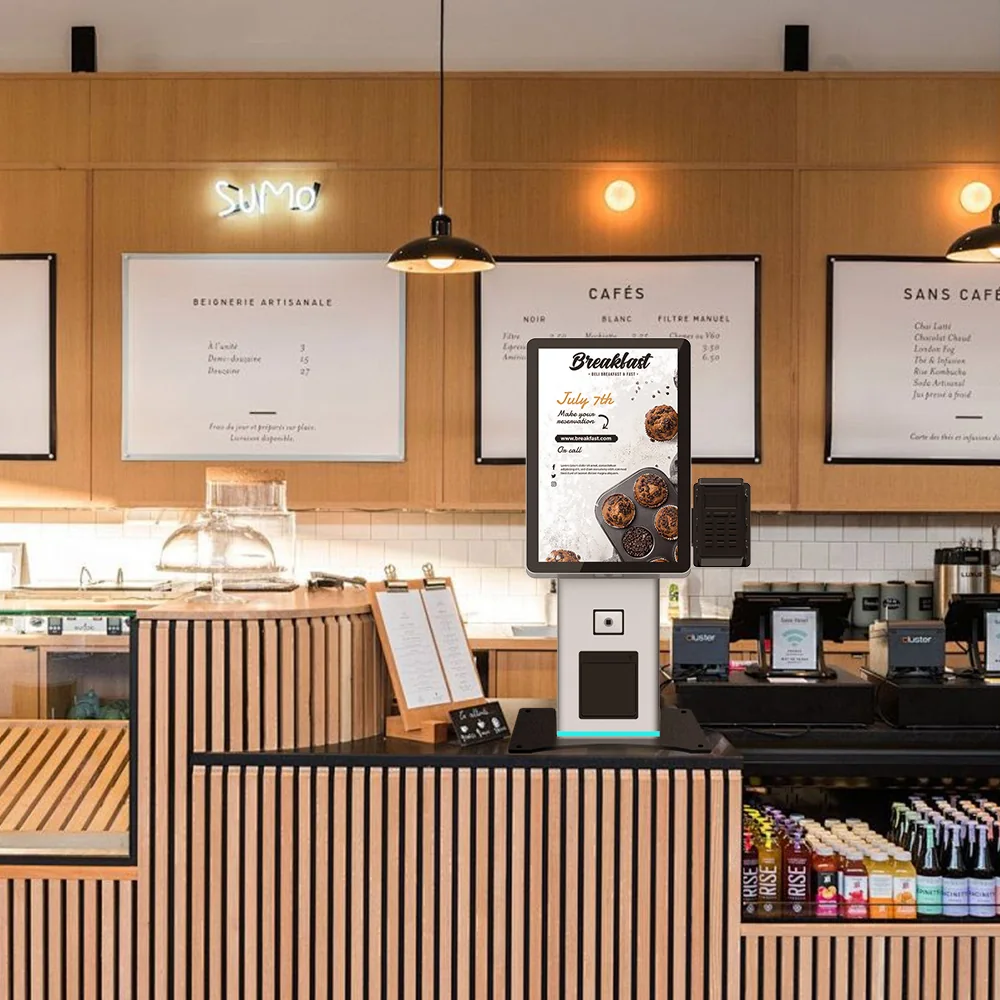
Then close the loop on the hardware itself: our K236-series self-service kiosk platform is configurable around the reader, printer and cash modules, but the mix of optics and redemption logic is set by your stock and your backend.
Reconcile the offline queue after reconnection
Sync is not reconciliation. Export or inspect the local redemption ledger and match every event to a central transaction ID, timestamp, kiosk ID and credential identifier. Resolve exceptions by state: locally paid but not synced, synced but not paid, duplicate submitted, and rejected after local acceptance.
Require an audit trail showing which operator or automatic rule resolved each exception, so a dispute three weeks later can be traced rather than reconstructed. Rehearse power loss, network loss and repeated reconnect attempts — the test is ledger consistency, not whether the kiosk boots. Name the reconciliation owner and escalation path before go-live; unattended hardware still needs an operational backstop.
RFQ questions that expose integration risk
- Which credential types and symbologies does the reader support natively, and which require a different module or a software change?
- How does the kiosk expose idempotency, offline queue status, transaction logs and error codes to the integrator?
- What happens to a redemption when the network drops between validation and payout — provide a written state-transition description, not a verbal assurance.
- Will the supplier test our own ticket stock and phone samples, and what exactly will the test report contain?
One compliance caveat belongs in the RFQ too: cash payout of redeemed vouchers may be regulated where you operate, and the applicable rules must be confirmed locally. A kiosk vendor is not a compliance determination, and no hardware configuration should be presented as one. For adjacent configuration questions — enclosure, branding, module layout — see the unattended retail kiosk OEM enclosure checklist .
What the hardware decides, and what it does not
A configurable K236-series platform can carry the reader, printer and cash modules a redemption floor needs. It cannot decide your stock migration policy, your idempotency scheme, or how much offline redemption you are willing to authorize. No supplier can promise mixed-stock read performance without testing your actual tickets and your customers’ actual phones — treat any such promise as a scope gap, not a feature.
Send us a sample of your ticket stock for a read-test before you commit to a scanner. Include the faded, folded and damaged specimens alongside the clean ones, plus the phone models and brightness states you see on the floor, and tell us which credential should be redeemed offline. We will run the protocol above and return the specimen-level results, so your acceptance criteria are written against evidence rather than a demo ticket. You can also review the K236-series platform configuration or request the datasheet and a quote against your audited credential mix.
Troubleshooting questions buyers actually ask
Can a ticket redemption kiosk scanner read faded thermal tickets?
Some can, within limits that depend on remaining contrast, bar-edge definition, quiet-zone damage and the symbology in use. The only reliable answer comes from scanning your faded stock under your venue lighting and recording results per specimen. Ask for that report in writing rather than a general claim.
How do I stop a kiosk from accepting the same ticket twice while offline?
Use a unique redemption ID with an idempotency key, write the decision to durable local storage before paying out, bound offline operation by time or value, and sync ordered events with explicit acknowledgement on reconnection. Duplicate prevention lives in the state machine, not in the reader.
Can a phone screenshot fool a QR code kiosk reader?
A screenshot decodes perfectly, so decoding is not the control. The control is server-side validation of a token, its expiry, redemption state and duplicate status — tested by replaying a screenshot immediately after a legitimate scan.
What should I send for a ticket-stock read test before ordering?
Stratified samples of every credential type you accept: clean and damaged paper tickets, card stock, wristbands, worn NFC and magstripe cards, plus the phone models and brightness conditions typical of your floor. Add the offline scenario you expect to run and your required reconciliation fields.