Quick answer: Choose by ticket mix, not unit price. A coin-led floor paying small prize tiers needs a multi-denomination coin hopper. A payout-heavy site paying large single values needs a cassette note dispenser. A site with roughly balanced accept-and-pay traffic needs a note-to-note recycler. Most redemption floors ship as a hybrid of two of these, not one.
Start with your payout profile, not the module price
Choose by ticket mix, not unit price. A coin-led floor paying small prize tiers needs a multi-denomination coin hopper. A payout-heavy site paying large single values needs a cassette note dispenser. A site with roughly balanced accept-and-pay traffic needs a note-to-note recycler. Most redemption floors ship as a hybrid of two of these, not one.
That is the whole decision rule. Everything after it is about writing the choice into a tender so that three suppliers bid on the same mechanism instead of three differently named ones.
Before the first supplier call, collect four inputs. They are the only inputs that change the answer:
- Ticket-value distribution. What share of redemptions falls below your smallest note denomination, and what share sits just above it. The second group is where payout ceilings fail.
- Payouts per day and per peak hour. Daily count sets refill frequency; peak-hour count sets the queue you get when a store empties.
- Share of transactions needing more than one denomination. A single-denomination payout is a different machine requirement from a two-note-plus-coin payout.
- Days between refills you can tolerate. This is an operational constraint you set, not one the supplier should set for you.
A cheaper module that shortens your refill interval converts a capital decision into a permanent labour cost, and that cost does not appear on the quotation. Write the tolerable refill interval first, then ask which module meets it.
Fix the vocabulary first: three payout families and the naming trap
Terminology in this category is vendor-specific. “Hopper” is used for coin dispensers, for note stackers and occasionally for a cassette. “Dispenser” is used both for one-way cassette payout and, loosely, for a recycler. “Recycler” is sometimes softened to “dispenser with recirculation.”
This is not pedantry — it breaks tender comparability. A published example sits on our own desk: in a comparison of published OEM specs against a fixed-configuration kiosk , one model sheet carried a “bill dispenser” row that actually described a coin hopper holding three denominations. The document itself flagged the label/description conflict as needing confirmation before the final bill of materials. If that ambiguity can survive inside one supplier’s sheet, it will survive across three competing bids.
Define each module by mechanism in your own spec, not by the supplier’s product name:
| Spec field | Coin hopper | Cassette note dispenser | Note-to-note recycler |
|---|---|---|---|
| What is physically in the store | Coin, staff-loaded, typically one hopper per denomination | Notes, staff-loaded cassettes | Notes sorted by denomination in a single circulating reserve, fed by customers and topped up by staff |
| Relationship to the acceptance path | Independent of intake | Independent — payout does not depend on what the previous customer inserted | Shared — the payout store is the intake store |
| Who supplies the inventory | Staff, from floor float | Staff, from prepared cassettes | Customers plus staff top-up |
| What bounds a payout | Hopper count and coin capacity per denomination | Denominations loaded and notes presented per cycle | Denominations actually circulating at that moment |
| Float character | Dead capital until dispensed | Dead capital until dispensed | Reduced pre-load, because notes are reused |
Is a hopper the same thing as a cash dispenser? Not reliably. Require every bidder to name the mechanism, the note or coin path, and whether the payout store is filled by customers or by staff. Treat the label as marketing and the mechanism description as the specification.
Where each route bites on an FEC redemption floor
Coin hopper
Inventory is staff-loaded coin. Payout combinations are bounded by hopper count — three hoppers means three coin values, and a prize tier priced outside that set becomes a note problem or a counter problem. Refill frequency is driven by peak-hour coin volume against hopper capacity. Jam recovery is usually a hatch open, clear the chute, re-home the hopper, and reconcile the coin count against the audit log. The realistic failure mode is not a jam but a hopper running dry mid-shift while a queue forms at the counter — which is why the customer-facing behaviour matters as much as the mechanism.
Cassette note dispenser
Inventory is staff-loaded notes on a path separate from acceptance. That independence is the operational advantage: payout never depends on what the last customer fed in. The cost is a float that sits idle until dispensed, and a refill cycle driven by note payout volume against cassette capacity. On a strictly cash-negative site — payout only, no meaningful intake — this is the structurally correct choice, and the recycler’s float advantage does not exist because there is nothing to recirculate.
Note-to-note recycler
One reserve is accepted, sorted by denomination and re-issued. That is what actually cuts the note float loaded before opening, and it is the mechanism, not a marketing claim. The hidden risk is that the payout ceiling becomes a function of what is circulating at that moment rather than what you loaded. A recycler that has taken in mostly low denominations all morning may be unable to pay a high-value ticket without a top-up.
On fit, Valuetec’s teller-environment field view is worth carrying into your evaluation: recyclers suit sites where cash in and out are roughly even, and generally hold efficiency gains up to about a 70/30 in/out split, beyond which unload/reload time can offset the savings ( Valuetec, “Is a Recycler or a Dispenser better for me? (Part 2 of 4)” ; no publication date or method stated in the source — treat as a planning heuristic from a teller environment, not a measured benchmark for arcade redemption).
For all three routes, add one line to your spec: what the customer sees when the store runs dry mid-transaction — part-payment, void, or a printed claim ticket — and who reconciles it at the counter. Suppliers answer this question very differently, and it is the difference between an incident and a complaint.
The hybrids that actually ship — and which venue each fits
- Acceptor plus cassette dispenser. Lowest-cost cash-in/cash-out pair, two separate stores, highest float exposure, simplest service story. Fits payout-heavy arcades with modest deposit volume. Do not buy this if your intake is large enough that you are manually emptying an acceptor stacker every day.
- Note dispenser plus multi-hopper coin dispenser. The mainstream redemption fit: notes clear the high ticket tiers, hoppers cover the small-change tail. The real specification decision here is hopper count, not the note module — hopper count is what determines how many coin values you can return without a counter intervention.
- Recycler plus coin hopper. Fits venues with meaningful cash-in (entry, card top-up, bill-fed gameplay credit) and coin-heavy payouts. The recycler absorbs the accept/pay imbalance; the hopper handles metal. This is the configuration most often proposed for a mixed floor, and the one most often over-specified for a payout-only floor.
- Recycler without coin. Rarely sufficient for ticket redemption unless every prize tier is priced in note increments. Say it plainly rather than accept the premium module by default.
Do I need a recycler if my venue is almost entirely payout? No — a recycler’s economics come from reusing customer notes, and a payout-only site supplies none. The premium buys you a float advantage you cannot use.
What actually limits your single-transaction payout
A brochure “maximum payout” figure is meaningless without three things stated alongside it: the denomination set loaded, the loading state assumed, and the cycle behaviour. Break the ceiling into its components and ask about each:
- Which denominations are loaded, and therefore which note combinations are possible at all.
- How many notes a single cycle presents.
- Whether the unit can chain multiple cycles inside one transaction, and under what software limit.
- Coin hopper capacity per denomination, which caps the coin portion of a mixed payout.
- Any software-level maximum the vendor applies for risk or reconciliation reasons.
Then map your own top three prize tiers against the proposed denomination set. A tier priced just above the largest loaded note forces a multi-note payout that may hit the cycle cap — and that is a design failure you discover on a Saturday afternoon, not in a datasheet.
Note also that payout ceiling and float are the same conversation. Every increment you add to the ceiling adds to the pre-load, which is precisely the trade the recycler is arguing about. Demand the ceiling answer as a worked example using your ticket values, not a round-number demo.
Put these eight questions in the tender, in writing
- Per-transaction denomination combination capability, with the exact loading state assumed.
- Maximum single payout, and whether the cap is a software limit, a cycle count or a physical capacity limit.
- Cassette and hopper capacity in notes or coins per denomination, plus the reload procedure and the time it takes one person.
- Refill trigger: sensor level, transaction count, scheduled visit or remote-monitored — and who receives the alert.
- Jam and fault recovery, step by step, including what the customer sees and what the counter must reconcile afterwards.
- Remote alert item list: which fault classes report out, over what channel, and the escalation path.
- Wear-part list with stated replacement intervals and who stocks the parts — treat any interval as supplier-stated until you have seen field data.
- Module substitution and spares continuity: can the chassis accept a different dispenser or recycler platform later, and what happens to spare-parts supply if the programme ends.
What is a realistic jam rate for a note dispenser? There is no publicly citable figure — jam rate, MTBF and dispenser failure data are not published in any form we can verify for this category. That is an evidence gap, not an omission. Replace the number with question 5 above plus the acceptance test below, and refuse to sign a service contract whose response times are not tied to those written answers.
Accept it like an operator: the four tests that expose a bad fit
- Distribution stress test. Run a defined number of consecutive payouts using your real ticket-value distribution, during an emulated peak hour, and log every partial payout, retry and fault.
- Low-inventory boundary test. Drive each cassette and hopper down near empty and record the exact behaviour: refusal point, message shown, part-payment handling. That is the state your staff will actually meet.
- Media condition test. Folded, torn, taped and limp notes, plus mixed coin condition. Recycler performance is entangled with note quality in a way cassette dispensing is not, so this test changes result by route.
- Interruption and reconciliation test. Pull power and network mid-payout, then verify the audit trail lets you reconcile what was paid, what was voided and what the customer claims. This is the most frequently skipped test and the most frequently disputed incident.
Define pass/fail thresholds and sample sizes inside the tender document. A factory demonstration on clean notes is not an acceptance run.
Compliance and cash-handling duties
Cash-accepting and cash-paying terminals carry record-keeping, reconciliation and physical-security duties that vary by jurisdiction, and by whether the site operates under a licensing regime. Confirm the applicable requirements with local counsel — this section is not legal advice. Two practical consequences for the spec: ask which audit-trail and settlement-reporting fields the module and software expose, because those fields determine whether your reporting obligation is achievable without manual counting; and write physical security of the payout store — safe, door, access logging — into the same specification rather than treating it as an afterthought.
Next step: turn your payout profile into a configuration sheet
Request the dispensing-module configuration sheet and a sample-unit quote matched to your ticket-value distribution. To get a specific reply rather than a brochure, send six things: target market (US or EU), kiosk format, payouts per day, your ticket-value distribution, the denominations you must return, and whether you need intake as well as payout.
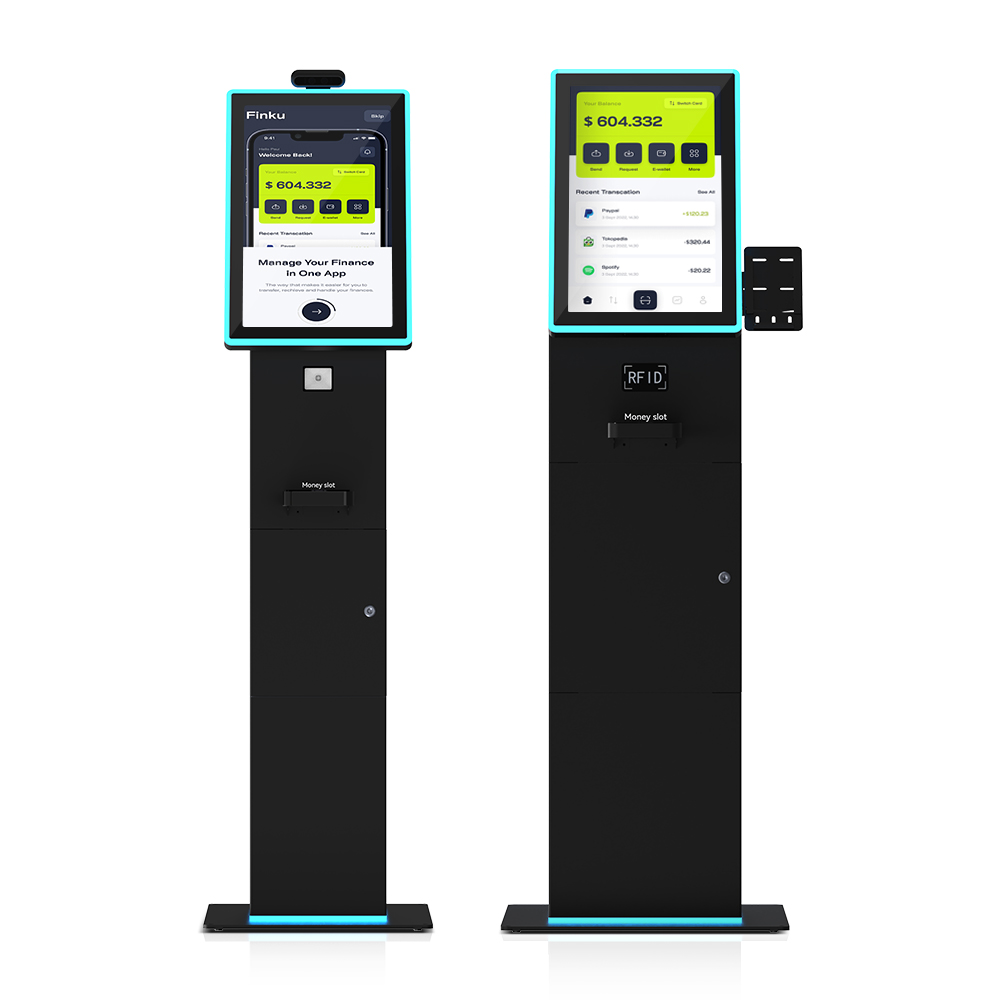
Our freestanding cash-handling self-service kiosk is a starting point for configuring dispenser, recycler and hopper combinations on one chassis; module options, MOQ and lead time are confirmed against the final bill of materials, not a marketing sheet.
Choose the route first, define each mechanism in your own words, then let the bids compete on the same specification. Two companion reads: the cash redemption kiosk peripherals BOM checklist for the full module list around the payout path, and choosing between cash, card and biometric payment hardware if your tender still spans payment methods.